 to give an insight into the life, structure and inventory of a Bulsa compound in the rural part of Northern Ghana.
EXHIBITION OF BULSA CULTURE
"15 women and 9 ancestors, life and religion of the Bulsa of Northern Ghana"
 With the number of Africans studying or working in Germany continuously increasing it
is perhaps a good time
to illustrate African everyday-life and its material culture in an exhibition, to make them known to a larger public and
remove old prejudices. While most ethnological publications are aimed at a
specialized academic readership, an
exhibition tries to address different social groups at different educational levels: school classes and their teachers, university
students, people of all ages who are interested in foreign civilisations and possibly even
those whose culture is
involved.
With the number of Africans studying or working in Germany continuously increasing it
is perhaps a good time
to illustrate African everyday-life and its material culture in an exhibition, to make them known to a larger public and
remove old prejudices. While most ethnological publications are aimed at a
specialized academic readership, an
exhibition tries to address different social groups at different educational levels: school classes and their teachers, university
students, people of all ages who are interested in foreign civilisations and possibly even
those whose culture is
involved.
This exhibition attempts to give an insight into the life, structure and inventory of a Bulsa compound in the rural part of Northern Ghana.
Starting in the beginning of 2004, Miriam Grabenheinrich (M.A., Institute of Ethnology, University of Münster) had the
idea of having an exhibition on Bulsa culture, based on Franz Kröger's collection of Bulsa material objects in the
Institute. At an early stage, she found collaborators for this project in Dr. Sabine Klocke-Daffa, Kerstin Brünenberg
(M.A.), Dr. Franz Kröger, and subsequently in about 21 students of ethnology.
Three professors,
Hartmut Brückner, Norbert Nowotsch and Dr. Reinhold Happel kindly joined
the project together with three students of the
Fachhochschul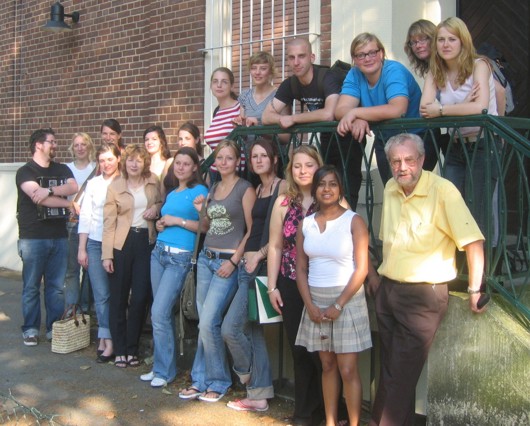 e Münster (University of Applied Sciences, Department of
Design).
e Münster (University of Applied Sciences, Department of
Design).
The exhibition concentrates on Anyenangdu Yeri, a big compound in Wiaga-Sinyansa and its inhabitants. After a general representation of Northern Ghana and the Bulsa, the visitor is lead through different departments of the exhibition showing important aspects of Bulsa culture and everyday life, e.g.:
The compound: Anyenangdu Yeri and its families
Children at home and at school
House and household of a woman
Religion: ancestors, shrines, soothsayers
Crafts, agriculture and market
Cultural Change and globalisation (Bulsa in Germany, the ethnographer)

(1) everyday life in a traditional compound, (2) sacrificing to an ancestor and (3) a Bulsa family in Accra. A visitor who wants to learn more about Bulsa culture can find information in an accompanying book (edited by Miriam Grabenheinrich and Sabine Klocke-Daffa), which includes contributions by Bulsa and German authors (Ghanatta Ayaric; Pauline Akankyalabey; Rüdiger Schott, Barbara Meier, Ulrike Blanc, Miriam Grabenheinrich and Franz Kröger).
More information on the exhibition (in German) can be found on the website of the Westfälisches Museum für Naturkunde Münster