Evans Akangyelewon Atuick
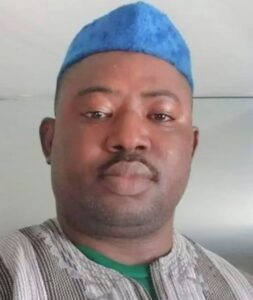 (Ghanatta Ayaric:) Evans Akangyelewon Atuick passed on. The sudden death of Evans was a deep shock to many Bulsa. Known and liked by many for his jovial nature, the man with the bass voice was a promising academic pursuing a PhD programme in the US. Buluk is particularly grateful to him for his for insightful articles and contributions to Bulsa culture and society. He was founder and club manager of Wiaga FC, an affable youth leader in every sense of the word, and an illustrious son of not only Wiaga but the entire Bulsaland. He had returned to Ghana for his field research work when the unthinkable happened. Evans will always remain in loving memory.
Franz Kröger
Evans Atuick and his family of collaborators
Ethnologists need many helpers when conducting research in a foreign country, particularly informants with a good knowledge of their own culture and assistants to transcribe recorded texts and translate them into English. They also need people who can help with transport problems or use their political influence to keep a protective hand over the researcher. While working with the Bulsa, it is not difficult to find such collaborators from different lineages or sections. However, it rarely happens that a single family can consistently provide capable helpers and collaborators. When an expert informant is available, it is sometimes not even necessary to elicit data piece by piece or obtain the help of an interpreter. The late Evans Atuick not only had a great deal of knowledge about his own culture but was also able to offer this knowledge in scientific English to anyone thirsty for deeper insights into Bulsa culture. Evans’ essays have, therefore, been published almost unchanged by the editors of the journal Buluk (cf. Ghanatta’s obituary in Buluk 15).
During my first years of field research, Leander Amoak from Wiaga Badomsa was my most important helper. He was not only interested in providing me with data about Bulsa culture but was also keen to expand his own knowledge – which was somewhat limited due to his school attendance outside of the Bulsa country – by learning from Bulsa elders. In this situation, it was natural that we went together to see the most competent authority on Bulsa culture and history, Asage Adum, who was the oldest man in Badomsa at the time (1981). Because of his frailty and blindness, he was no longer able to do physical work, and he had also given up his activities as a diviner. When we met, I had the impression that he had complied with our requests for information out of politeness despite the fact that he appeared to take great pleasure in sharing his extensive knowledge with two inquisitive supplicants. His knowledge was truly extraordinary. He was not only an expert on his own lineage and section; he could also report in detail on sections far removed from Badomsa, give genealogical overviews and report on their history.
One day he asked us if we knew that some Bulsa also worshipped their ancestors in stone figures (sic), and then he told us in detail about the terracottas and the oldest history of the inhabitants of Wiaga-Zamsa. The next day, Leander Amoak and I rode to Zamsa on a moped and took note of the terracottas. After a thermoluminescence dating at the University of Heidelberg in 1985 and a visit to Yikpabongo (Komaland), I reported the find to the Department of Archaeology in Legon (Accra), and after a short time, Professor James Anquandah began excavations. Therefore, Asage Adum had a share in the scientific discovery of the so-called Komaland terracottas, which are now known worldwide (see Google under the keyword ‘Komaland terracotta’).
Asage’s son Amoak took over the divination office from his father. In 2008, he was one of my most important sources of information about divination. He explained all the symbolic objects in his divination bag to me and even allowed me to film an entire divination session. In 1981, Asage’s son Hilary Atuick was my assistant before I had my permanent residence in Anyenangdu Yeri (Badomsa). Hilary’s wife, Rita Asiuk, a full sister of the present Wiaga chief, was also my informant, friend and patron of my work. On several visits, Rita showed me how soap is made from shea nut butter and caustic soda.
Evans’ brother-in-law, Thomas Kofi Alonsi, was the district chief executive of the Bulsa-North District. In this position, he twice provided me with a pickup truck in 2005 and 2006, whose driver took me to the Koma in Yikpabongo and picked me up again at the end of my research there. Without this help, I would not have been able to obtain the results of my work with the Koma at that time (see Kröger 2010).
Evans’ cousin (see genealogical table), Margaret Arnheim, née Lariba Bawa, became my most important collaborator in writing a Buli-English dictionary after she moved to Germany. Without her extraordinary linguistic expertise and her great willingness to take on monotonous tasks, which often consisted of making corrections and clarifying the tonal heights of Buli words, the dictionary would probably not have been published.
Finally, I would like to thank Evans and all my living and deceased helpers from his nuclear and extended family. They have contributed considerably to the research into Bulsa and Koma culture.
