KAPITEL X
DIE (KUUB-) JUKA ODER NGOMSIKA TOTENFEIER
1. Einleitung zur Juka-Totenfeier
1.1 Besuchte Juka-Feiern des Autors
Vom Autor (F.K.) wurden vor allem zwei Juka-Feiern besucht und durch Nachfragen ausgiebiger dokumentiert (Asiuk und Mutuensa), über eine weitere Feier in Chiok (Mai 1990) konnten nur einige Informationen durch meine Helfer gesammelt werden. Eine wichtige zusätzliche Informationsquelle ist daher die Beschreibung von Joseph Aduedem (ausführlich 2019 und gekürzt 2020: 54-61), die er aufgrund einer Befragung seines Großvaters Alanjo Aduedem (Sandema-Bilinsa) angefertigt hat.
• Juka Funeral in Wiaga-Mutuensa (Ajusong or Ajuyong Yeri) für einen verstorbenen Wahrsager: 24.-27.4.1989; Teilnahme: 24.4. (cheesika/bogsika, fn 88,270), 27.4. (lokta juka dai, fn 88.270+272)
• Die Juka Totenfeier für den verstorbenen Wiaga Häuptling Asiuk (im folgenden abgekürzt durch “Asiuk”): 6.7. – 12.7. 1994; Teilnahme: 9.7. (sira manika dai, fn 94,14+15a). Am 10.7. (lokta juka dai) fotografierte Danlardy in meinem Auftrag Riten und sammelte Informationen.
• Chiok, Mai 1990 (fn 88,305b): senlengsa dai in Wiaga Chiok. Meine Helfer Danlardy und Adama machten Fotos und sammelten Informationen.
1.2 Allgemeine Informationen über die Juka
Namen: Juka = Verbrennen (der Köcher usw.); J. Agalic u.a.: kuub juka = burning the funeral; ngomsika = Kratzen. Eine einleuchtende Erklärung für diesen Namen konnte ich nicht erhalten. Wenn nur das Kumsa-funeral abgeschlossen wurde, sagt man, dass nur eine Hälfte zelebriert wurde (nye kuub zaani).
Zeitpunkt und Bedeutung: Obwohl erst die Juka-Feier den Einzug des Verstorbenen in das Totenreich (kpilung) ermöglicht, scheint man mit ihrer Abhaltung im Vergleich zur Kumsa keine große Eile zu haben. Oft liegen viele Jahre zwischen Kumsa und Juka. Ein Grund mag sein, dass die in der Stellung des Verstorbenen amtierenden Nachfolger ihre soziale Position und den verwalteten Besitz (Ländereien, Vieh) des nach der Juka Ahnenstatus erlangten Mannes an den nach der Genealogie wahren Nachfolger abgeben müssen (siehe Kröger 1982 und 2003). Ein großer Nachteil einer langen Verschiebung der Juka wäre es, dass auch gebärfähige Frauen lange auf eine Wiederverheiratung warten müssten. Heutzutage erlaubt man ihnen jedoch eine neue Beziehung, die dann am 3. Tag der Juka (siehe 2.4.7) durch die Wahl der Witwe einen ganz offiziellen Status erhält.
Die Aussagen verschiedener Informanten und Autoren weisen untereinander Widersprüche auf, die hier nicht weiter untersucht oder berichtigt werden konnten
Information Margaret Arnheim (fn M28a): Erst durch die Juka/Ngomsika Feier wird man Ahne. Für den/die letztgeborene(n) Sohn oder Tochter wird die Juka nicht ausgeführt, aber er (sie) wird doch Ahne.
U. Blanc (2000:221): Insgesamt wird die Vielfalt von musikalischen Darbietungen der Kumsa-Totenfeier nicht erreicht.
Aduedem 2020:54: This part of the funeral celebration takes four days… In the case of a man of status (kpagi), who was also a yeri nyono and had sacrificed to great ancestral gods, it takes six days.
2. Chronologische Auflistung der rituellen Ereignisse
Vorbemerkung: Die Namen der Festtage und der Verteilung der Ereignisse auf die verschiedenen Tage scheinen nicht völlig fest zu liegen. So wurden im Gehöft des Häuptlings Asiuk nicht am 3. Tag, der dort auch Lok tuilika (Wenden des Köchers) oder Sira manika genannt wird, die wichtigen Riten der Verbrennung der Köcher und Zerstörung der Töpfe ausgeführt, sondern am 4. Tag, der dann Lokta juka genannt wird. In Mutuensa wurden Köcher und Töpfe am 3. Tag zerstört, der hier auch Sira manika oder Lokta juka genannt wird. Wenn am 3. Tag die Waffen verbrannt werden, heißt der 4. Tag Senlengsa dai.
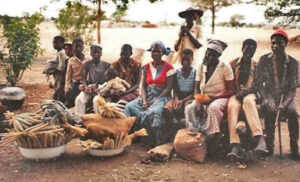
Cheesika: Eine Mutuensa-Gruppe hat in Chiok Nahrungsmittel gesammelt
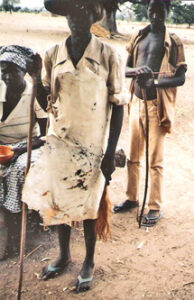
Cheesika in Chiok: Die Mutuensa Imitatorin
2.0 Vortag: Cheesika (Einsammeln) oder (Lehnwort Twi) Bogsika
Ajuizong Yeri Mutuensa, Wiaga, (fn 88,270a), 24.4.89: Gleichzeitig oder überschneidend mit Aktionen im Haus des Verstorbenen sammelt eine vorwiegend aus Frauen einschließlich der Witwe bestehende Gruppe aus diesem Haus Nahrungsmittel für die Feier in allen Gehöften der Sektion der Mutter des Verstorbenen, aber auch in anderen Häuseern der Sektion (hier: Chiok). Begleitet wird die Gruppe von der Imitatorin mit langem Mantel und tangkalung-Schurz und einem Mann, der den Bogen und Köcher mit Pfeilen des Toten trägt (siehe Foto). Das Foto zeigt Körbe und Schüsseln mit Kolbenhirse und geschenkte Hühner.
Information Yaw (fn 08,112b): Gesammelt werden zum Beispiel Hirse oder gekeimte Hirse (für kpaam ngabika des folgenden Tages). Nur Frauen geben direkt Spenden. Ein Mann kann etwas durch seine Frau geben lassen.
Aduedem 2019: 23 (revised): [Nach Aduedem finden diese Bettel-Besuche in Sandema am 1. Tag, Kpaama ngabika, statt].
Then they call the widow and ask her to go and beg for resources to perform the final funeral rites of her husband. This begging symbolises the dependence of the widow on the generosity of society.
She could go to one house in the morning, one in the afternoon and one in late afternoon. In any of these three rounds, when she gets to a house the men will give her zaa (millet) while the women could give her ingredients, shea nuts, etc. When she has taken enough rest after the third round, she goes to her san-yigma (link man’s) house. He takes her to a diviner (baanoa) and divines for her. They will both return to the san-yigma’s house and the san-yigma’s wife prepares TZ (millet porridge, Buli saab) for her to eat. The san-yigma then brings her back in the night, by which time they would have ground the kpaama (pito malt) waiting for her to come before they put the malt-flour (kpaam-zom) into water.
Azognab 2020: 50, Information durch Atombil Andoagelik, Sandema 2018, [Nach Azognab finden diese Bettelgänge am 1. Tag, Kpaama ngabika, statt]. This [the first funeral day] is also the day the pikogi (widow) is made to go round the community to beg for food items such as millet, beans, groundnuts and others if the deceased person was a married man.
Ajuick 2020: 89: (am ersten Tag): The kuub-juka rites normally start with a journey to the maternal uncle’s compound of a deceased man or the paternal compound of a deceased woman for two main reasons: to collect things for the performance of the final rites… The cheri-deiroa [cheri-dieroa, Imitatorin] must dress up in the deceased’s clothing and animal skin, carry his walking stick, etc., if he was a man, or carry her basket and food stick if she was a woman, and follow the travelling team to the compound of the deceased. The travelling team to a deceased man’s maternal uncle’s compound usually includes children of the deceased, one or two of their kinsmen, the cheri-deiroa, and her female escort(s). The travelling team that goes to a deceased woman’s paternal compound includes her children, the san-yigma [her marriage intermediary], one or two kinsmen, the cheri-deiroa, and her female escort(s). As soon as they arrive at the compound, the cheri-deiroa continues her role as impersonator of the deceased…
While this is going on, the delegation enters the compound and sends for the elders to inform them about their mission. The leader of the delegation, speaking on behalf of the rest, exchanges pleasantries with the elders and says to them, “Your son (or daughter) wants to go home and that is why I have come to inform you before giving him/her permission to go home and rest.” After this, the delegation is fed and refreshed by the family before rising up to start their compound-to-compound rounds within the lineage for the collection of foodstuffs, especially millet and sorghum, as well as guinea fowl and other domesticated fowl that they can catch or kill. During this compound-to-compound travel, the delegation will visit every compound on the maternal side of a deceased man’s lineage or the paternal side of the deceased woman’s lineage, for the collection of foodstuffs and birds. The cheri-deiroa, just like her late parent-in-law used to do, has license to play with any of her uncles by catching any livestock that belongs to him without any resistance. Hence, with the assistance of her team, she can catch and kill as many birds as she can, as long as the birds are found in any of the compounds in the paternal lineage of the parent-in-law she is impersonating. After they have covered every compound within the lineage, collecting everything they need to collect, they will return to the original compound the deceased is related to or hails from…
2.1 Erster Tag: Kpaama ngabika dai (preparing malt)
Ajuzong Yeri, Wiaga-Mutuensa (fn 88,270-73, Teilnahme F.K.) Das Funeral wird abgehalten für
1. einen verstorbenen Wahrsager, der mit einer anwesenden Aschanti-Frau verheiratet war
2. für die in Mutuensa verheiratete Akandetuire, eineTochter aus Abasitemi Yeri (Badomsa)
3. eine Frau aus Atana Yeri (Chiok)
4. eine Frau aus Wiaga-Yisobsa
5. eine “Tochter des Hauses” (yeri lie), die nicht im Hause ihres Ehemannes gestorben war.
Leanders pok nong kam aus diesem Haus, daher ist seine Frau Afulanpok anwesend.
2.1.1 Elders im kusung
Aduedem 2019: 22f: On the first day, every nisomoa and yeri nyono comes to the house with millet (zaa) and the woman who ‘sat on the funeral’ (presiding woman) comes to sit with the widow (jam kali wa ngaang – literally, comes to sit behind her). When the elders arrive, they sit in the kusung dok as usual with their zaa (millet). The zaa are mixed together (from the various sources) and put into two traditional baskets (busiksa). The sons/relatives provide tobacco (tabi), a fowl and an animal… which are taken together with some of the millets from the two baskets to the grave by the gravediggers for the vorup chiesika rituals [Aduedem: chiesi =to collect; it refers to the kobisa bringing millet; zu den Ritualen am Grab siehe 2.3.17 und 3.].
After that they come to the house and the elders thank them. The elders will then call the presiding woman [chelie or kuum zuk kaliba] to the kusung and give her some of the millet and kpaama – pito malt; germinated guinea corn grains (first stage of brewing pito [Endnote 97]) – provided also by the sons/relatives to grind for them (symbolically it means to prepare pito for them). When she takes the zaa and the kpaama inside, the sons/relatives now add a good quantity of pito malt that will be enough for the funeral celebration. However, after she has entered, the elders share the rest of the zaa in the two baskets among themselves.
2.1.2 Brauen des Hirsebiers und Eröffnung (announcement) der Feier
Frauen brauen Pito, der am letzten Tag getrunken wird. Nicht viele Leute sind anwesend
Aduedem 2019: 23f: The san-yigma then brings her [the widow] in the night, by which time they would have ground the kpaama (pito malt) waiting for her to come before they put the flour (kpaam-zom, [Endnote 98] into water.
When the kpaam-zom is kept in water, they announce [the funeral] by shouting: “ba pa baan yuni yooo” (i.e. they have taken the diviner’s bag). This announcement is proclaimed from one house to the other. Then every relative (especially the sons) will now start preparing their pitos for the fourth day.
Atuick 2020: 90: Following their return, they must buy or make fermented millet malt for the brewing of the kpaam-tiok [pito brewed especially for Juka purposes] to be used for the commencement of the Juka rites. After the malt is ground in readiness for the brewing of the kpaam-tiok and the date is set for the start of the final rites, a messenger, usually any male kinsman or a san-yigma, is sent to the paternal compound of the deceased man’s mother or that of the deceased woman to invite them to come and join them. Where the deceased was a man, men from the maternal uncle’s compound may choose to arrive the next day to participate in the drinking of the kpaam-tiok or wait until the third day of the rites to join them.
2.1.3 Gäste schlafen bis zum Ende der Juka-Feier im Funeral-Haus
Aduedem 2019: 24: People start to sleep at the funeral house from that day (gua kusung).
Azognab 2020: 48: It must be stated that during both the burial and the dry funeral rituals, the men of the community are expected to sleep outside by the funeral house each night as a custom.
2.2 Zweiter Tag: Nyaata soka dai oder Jueta soka dai (‘Tag des Bades’) oder Juem soka dai (the day of the ritual bathing of the widows)
2.2.1 Nachmittags werden Gäste begrüßt und Reden gehalten.
2.2.2 Vorbereitung der Witwen
Ajuzong Yeri, Wiaga-Mutuensa: Es gibt 10 Witwen (8 aus Ajuzong Yeri, 2 aus einem Nachbarhaus, Akabere Yeri?). Sie tragen entweder vorne und hinten Blätter (oft vom Nim-tree) oder vorne Blätter und hinten einen roten Faserschurz (vaata, siehe Foto).
Abends wird am tampoi Wasser in samoansa-Töpfen gekocht. Es werden auch ein liik (für kaltes Wasser?), chengsa und kpalabsa gebraucht.
(Nicht beobachtet:) Die Körper der Witwen werden zum Schutz vor dem heißen Wasser von der jom-suiroa-Frau dick mit Schibutter eingerieben. Wenn eine Witwe Verbrennungen bekommt, bedeutet das, dass sie ihrem verstorbenem Gatten nicht treu war.
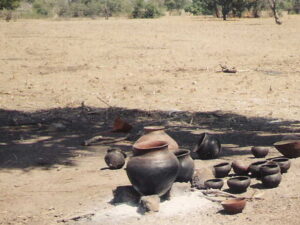
Ajuzong Yeri: Der Badeplatz nach dem Bad
2.2.3 Kopfschur und Bad der Witwen (nicht beobachtet)
Ajuzong Yeri, Mutuensa (fn 88,270): Die Witwen in Blätterkleidung werden nacheinander nach dem Alter mit heißem Wasser aus Kalebassen übergossen: zuerst der Kopf, dann der Körper. Zuschauende Frauen äußern Beifall durch Ululation (wuuling oder weeling). Am folgenden Tag stehen noch große Töpfe (samoansa), aber auch chengsa, kpalabsa und ein liik am tampoi. Sie wurden zum Bad der Witwen verwendet (siehe Foto).
Asiuk (fn 94,15a): nach Informationen durch Danlardy Leander: Am Abend des 8.7.94 wird Wasser gekocht. Die 8 Witwen Asiuks erscheinen in Blättertracht. Ihre Körper werden ganz dick mit fester Schibutter eingerieben. Danach hockt sich die älteste Witwe am tampoi und man schüttet ihr mit einer Kalebasse heißes Wasser über den Kopf und dann über den Körper. Einige Frauen machen wuliing. Nachdem alle 8 Witwen hintereinander gebadet wurden, werden sie wieder in ihre Wohnhöfe geführt.
Anyenangdu Yeri (fn 06,Bf 1a), Information durch Agoabe (Brief 24.5.07): Das Bad der Witwen fand am tampoi statt. Die Organisation hatten Afulang aus Atuiri Yeri und Akanpigma aus Adum Yeri. Vor dem Bad wurde eine gaasika ausgeführt.
Aduedem 2019:24 (vgl. 2020: 55): Towards late evening, a woman sets water in a clay pot on fire on/by the rubbish heap (tanpoi) outside the house. The widow, surrounded by women is brought out to sit also by the tanpoi. Any widower (whose wife’s final funeral rites have been performed) is called upon and he comes to shave the widow. When the water (now called juom) starts boiling by night time then, the women ululate (nag weliing) in jubilation for the water boiling. There is joy because the boiling water shows there is no issue, for when there is a problem, the water will never boil until the issue is found out (through divination) and solved. When the water is boiling, the juem suoroa [Endnote 99] suoroa (a woman traditionally “trained” for that ritual) fetches some of it into a chari [Endnote 100], pours some quantity of cold water into it and baths the widow surrounded by women to form a wall. The widow is smeared with shea butter and daluk – “red clay paint (laterite; use for ritual painting of the body, e.g. at a funeral… [Endnote 101]) – before bathing her with the hot water. This ritual bathing is what is called nyaata soka or juem soka (water bathing) by which the second day celebration derives its name (nyaata soka dai). It is believed that “if the woman is innocent about the death of the husband, the hot water will never burn her”
(F.K.) Eine zweite Kopfrasur findet gegen Ende des Juka-funerals statt. Siehe 52.4.8.
Atuick 2020: 90f: The next day of the rites is reserved for the widowhood rites during which wives of the deceased are made to undergo a ritual cleansing bath. From the onset of the funeral rites, wives of the deceased are confined to a room where only a juenseiroa [Aduedem: juem-suoroa; woman appointed to care for widows and oversee the performance of their widowhood rites during funerals] has access to them. Only old widows living in a different compound who have not slept with a man since their deceased husband’s funeral rites were completed are qualified to play the role of juenseiroa. The widows cannot eat or touch anything associated with the performance of their husbands’ funerals until they undergo the ritual bath in the evening of the penultimate day of the juka rites. As a result, only the juenseiroa provides food and water for the widows pending the completion of the ritual to prove that they have not betrayed their late husband by having sex with another man. One of the juenseiroa’s key roles is to prevent men of the compound from getting close enough to be able to touch the widows, which would result in forcing such “contaminated” widows to choose the men who touched them as husbands after the rites.
Early in the morning, the san-yigma who performed the marriage rites of each wife must go into the bush with the juenseiroa to harvest leaves for the widows to cover their nakedness before undergoing the ritual bath. After putting on the leaves with ropes around their waists, solid sheabutter is smeared all over the bodies of the widows, after which boiling hot water is poured on each of them three times. It is believed that the hot water will only burn women who have not maintained their purity after the death of their husbands. From my observation, the thick sheabutter protects widows from any serious burns from the hot water because sheabutter is impervious to water. Thus, as soon as the hot water is poured on the bodies of widows, it runs down quickly due to the sheabutter smeared on their bodies, and so does not cause any serious burns.
Azognab 2020: 51-53:…As part of the widowhood rites, during the kuub-juka (wet funeral/burial) the widow is led through the main gate to the back of the house by other women where she will have the first ritual bath known as the gmanyaksoka [ngmanyak soka]… The gmanyak is identified among the Bulsa for purification purposes. In the juka celebration of the funeral, further purification rites for the widow are the zukponika (shaving of the hairs) and nyaata soka or jiuam soka (ritual bathing) explained earlier. I observed that both the shaving and the bathing is done in the night of the nyaata soka dai. The rituals take place outside, in front of the house at the family’s tampoi (ash heap or compost heap) where all the refuse of the household are dumped. In the early part of the evening the widow is brought out through the main gate of the house, again, with only the vata (leaves of the shea butter tree or other trees tied together) round the waist with a string tied around her head for the shaving and bathing on the ash heap or compost heap. She is seated at the ash heap or compost heap and is surrounded by a group of women and while the shaving and the bathing is going on, these women ululate. The ululating by the kolieba (married women in the community who hail from the same area of the widow to marry there), is to encourage the widow to bear the heat of the boiled water and also to praise her for her fidelity. This is because the Bulsa hold the beliefs that if the widow stayed morally pure during the widowhood, the water will boil easily and that, no matter how hot the water is, the widow will not feel the heat. In other words, the Bulsa believe that if the widow had been faithful to her husband, the water will not burn her, but if not she would feel the pain from the hot water. So the ritual bathing is also a test of the widow’s fidelity. In the ritual process, the widow’s hair is shaved first, then she baths with warm water boiled in the herbs, in fact, the boiled water is poured on her. This is done in the full glare of everybody. The women only form a queue around her. Formerly, the widow used to bath completely naked but these days, they are often permitted to bath with their under pants on. She baths with really boiling water…
According to the traditional beliefs of the people of Buluk, under no circumstance should a spouse refuse to go through the ritual during the funeral of her spouse. Unless the widow goes through the ritual, she is considered unclean. In the olden days, a spouse was banished from her husband’s home if she refused to go through the widowhood rites. The widowhood rites among the Bulsa can be very humiliating. Despite the fact that they are meant for spiritual separation of the widow from the deceased husband and incorporation into the society, it calls for modification to make it more humane and acceptable in contemporary times.
2.2.4 Mahlzeit der Witwe(n) am tampoi
Aduedem 2019: 25: After bathing, the juem suoroa prepares TZ and bogta soup with mud fish for the widow, still by the tanpoi. She eats that food alone, but any woman whose husband is late and the final funeral rites have been performed can eat that food too.
2.2.5 Die Witwen werden in ihre Wohnquartiere geführt.
Aduedem 2019: 25: When she has finished eating, the rituals for that day come to end and the widow is led inside. She will rub her back against the dalong before she enters inside the room to lie down.
Nach einigen Informationen kann die Gattenwahl der Witwen auch gleich nach dem Bad stattfinden.
2.2.6 Biisa lika (Schließen der weiblichen Brüste)
Information Anyiini (unverheiratete Frau aus Anyenangdu Yeri) 1997: Falls eine ältere verheiratete Frau verstorben ist, bringen ihre Töchter im gebärfähigen Alter einen samoaning zum Trauerhaus. Bei Auslassung dieses Rituals würde die Milch in den Brüsten der gebärfähigen Tochter “auslaufen” oder die Brüste würden mit Beulen besetzt werden.
2.2.7 Der poali-Lederarmring mit Medizin
Information Anyiini (Anyenangdu Yeri): Am 2. Tag der Juka legen viele Teilnehmer einen poali-Lederarmring mit Medizin an. Einige betrachten ihn als juju, andere “just for fun”. Dieser Brauch besteht im ganzen Bulsaland.
2.2.8 Vei [vie] cheesika
Azognab 2020: 50 (Information durch Atombil Andoagelik, Sandema 2018): In addition [to the widows’ bath], on this [second] day, every household in the community is expected to bring a basket of millet or sorghum to the funeral house to be shared. This is called vei cheesika (literary, contributing to the grave). Although these millet and sorghum are shared among the elders and the undertakers, it is believed they are for the deceased person as part of preparing him or her for the journey to kpilung (the land of the living dead).
2.3 Dritter Tag: Sira manika dai (Tag der Hirsebreizubereitung), lok tulimka dai oder lokta juka dai (Tag des Umdrehens oder Verbrennens der Köcher) oder (beim Funeral einer Frau) puuta-dai (Tag der puuk-Töpfe)
Besuchte Feiern (F.K.): In Ajuzong Yeri, Mutuensa, kam ich mit meinem Assistenten Danlardy Leander morgens am 27.4.89 um 5.45 Uhr am Gehöft an.
Das Gehöft des verstorbenen Chiefs Asiuk konnten Danlardy und ich am 9.7.94 erst gegen 16 Uhr besuchen.
2.3.1 Kpagluk-Opfer (Vgl. kpagluk der Kumsa-Feier, 2.2.1)
Ajuzong Yeri, Wiaga-Mutuensa, (fn 88,270b): Morgens um 4 Uhr wurden etwa 40 Hühner und 2 Widder (rams) getötet und ihnen die Köpfe ganz abgeschnitten. Ihr Blut floss auf Bogen, Pfeile und Köcher (nicht gesehen).
Hühner, die eintreffende Gäste als Geschenke für den verstorbenen Mann mitbringen, werden sofort an der linken Seite des Gehöfteingangs getötet, die Federn an die Wand geklebt und die Hühner sofort über dem Feuer geröstet. Der verstorbenen Frau bringt man hinter dem Haus Opfer dar.
2.3.2 Fellbeutel Orakel
Ajuzong Yeri, Wiaga-Mutuensa (fn 88,270b):
Gegen 8 Uhr morgens wird ein Fellbeutel (bunlok) geöffnet, in den man am Vortage Hirsekörner und flüssiges Schi-Öl gegossen hatte. Wenn das Öl hart geworden ist, ist es ein schlechtes Zeichen: man hat zum Beispiel einen Fehler bei der Totenfeier gemacht oder einer der Teilnehmer wird bald sterben. In dem aktuellen Fall ist das Öl noch flüssig.
2.3.3 zong-zuk-cheka: Musikanten auf dem Flachdach (vgl. 2.1.10 am Kumsa dai)
Asiuk, Auf dem Flachdach spielen Musikanten 3 ginggaung (Zylinder-Trommeln), 1 namuning (Horntrompete), 1 sinleng (Doppelglocke), 1 wiik (Flöte).
U. Blanc (2000-223): Das Trommeln auf dem Flachdach bei Anbruch des Tages signalisiert den Beginn des [Juka] Rituals. S. 221: Die kobisa des Verstorbenen sind für die musikalische Darbietung verantwortlich.
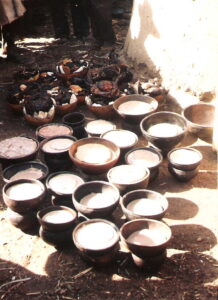
Ajuzong Yeri: Der zubereitete Hirsebrei
2.3.4 Zubereitung der Mahlzeit und Verteilung (auch für Opfer an den Köcher)
Ajuzong Yeri, Mutuensa, (fn 88,272a): Noch im Dunkeln des frühen Morgens bereiten die Witwen den Hirsebrei, der dem Köcher geopfert werden soll. Auch Nachbarinnen haben Hirsebrei mit Fisch (jum-goalik) und Yams zubereitet und bringen diese um 9 Uhr in einer Prozession in das Trauerhaus.
Später stehen hinter dem Speicher (bui) im Viehhof etwa 20 kpalabsa mit weißem oder rötlichem Hirsebrei (aus zamonta), darunter ca. 20 chengsa mit Sauce (siehe Foto) und viele Kalebassen mit Fisch, Yams, bumbota (essbare Knolle aus dem Buschland), koosa (Bohnenkuchen und suma (Rundbohnen).
Das für Besucher aus anderen Sektionen zubereitete Essen wird verteilt. Aus der eigenen Sektion dürfen nur Halb- und Vollwaisen davon essen. Es werden Namen der Sektionen hintereinander aufgerufen und der aufgerufene Vertreter diese Sektion kann sich ein Gedeck aussuchen. Eine gefüllte schwarze Kalebasse ist jedoch nur für die Opfer an den Bogen und Köcher und für die Elders reserviert. Einige “unverschämte” Gäste nehmen sich neben ihrem Gedeck noch den Fisch oder das Fleisch von einem anderen Gedeck. Sie können getadelt werden, aber man darf sie nicht daran hindern. – Auch uns wird Essen im Dabiak angeboten.
Asiuk (fn 94,14b): Über 20 Schalen mit Hirsebrei (zum großen Teil in chari-Schüsseln) und über 15 Kalebassen mit Huhn-, Perlhuhnfleisch oder Fisch sind bereit zum Verzehr. Auf dem Hirsebrei liegen zum Teil kamsa-Bohnenkuchen. Yams muss immer unter den Speisen sein, es darf aber nur von nahen Verwandten (Töchtern oder Witwen des Verstorbenen) zubereitet werden. Alles wird in das Quartier der Häuptlingsmutter gebracht und dort in den Zimmereingang gestellt.
Im kusung des Häuptlingsgehöft werden Reden gehalten. Hirsebreigerichte stehen im Quartier Agoldems (des ältesten lebenden Bruders Asiuks) und in fast allen anderen Innenhöfen. Sie sind aus anderen Gehöften gebracht worden. Auf einer Schüssel liegt eine rote Masse (= kamsa).
Viele Leute kommen noch mit Geschenken (z.B. Hühnern, Perlhühnern usw.). Sie müssen alles Agoldem, dem Bruder Asiuks, übergegeben. Auch eine Abordnung des Sandemnaab ist erschienen.
Information Godfrey Achaw, fn 73,48b: Die Nahrungsmittel werden im Raum des Toten bereitgestellt und im Innenhof ausgebreitet: Hirsebrei, Perlhuhnfleisch, Hühnerfleisch, Fleisch von Buschtieren, Trockenfleisch, Bohnenkuchen… Nachbarsfrauen helfen bei der Zubereitung, da viel gebraucht wird. Der chief mourner sagt den Frauen, wem sie die Nahrung geben sollen, indem er auf diese zeigt.
Information Yaw 27.1.06 (fn 06,6b): Hirsebrei wird auch lokta sira (Hirsebrei des Köchers) genannt.
Aduedem 2019: 25: On this day, they cook Bambara beans, yam, cakes (kamsa), jollof rice, bumbota (Tacca Leontopetaloides [Endnote 102]), and an animal may be killed for preparing TZ. When the kobisa are coming back on this day, each comes with TZ. By evening time, the TZ they prepared in the house is served in several earthenware bowls including one very big one. TZ in a big earthen ware bowl with a cake on top of the TZ is sent to the kusung dok for the elders, and another TZ and cake is given to the san-yigma of the widow for his toils. The yam is arranged around the TZ in a big chari [which will be given to the kobiik kpieng, the head of the kobisa], and the rice put on top of the TZ, the same with the bumbota. Now taking a chin sobli [Endnote 103], they put a number of mud fish, the Bambara beans, and the rice, inside it. Then all the TZs are arranged in the courtyard (dabiak) with the TZ in the big chari together with pots of pito. Then the elders in the kusung are called in and told that these are the TZs, they should use them to perform their funeral. The elders pick four bowls of the TZ with some pots of the pito and give them out to be kept in the kitchen (gbalong/gbanlong). Then they give one bowl of TZ to the siblings (if any) of the deceased. After that they ask all to snatch (chiak) the rest of the food.
Information Danlardy Leander: 17.4.96 (fn 94,87b*): Auch kamsa-Bohnenkuchen werden (einzeln?) an Verwandte, Nachbarn und Freunde verteilt.
Azognab 2020: 50 (Information durch Akaalie Aginteby, Sandema 2018): Every household among the kobisa (family lineage) in the community is expected to bring at least one kpalabk (a local ceramic bowl) of saab (millet porridge), with soup and either fish or guinea fowl meat in the evening of the sira manika dai to the funeral house. All this food together with the one prepared in the funeral house are presented and kept open in the court yard where the funeral takes place. This is described as sira zaaka (placing of millet porridge). After a speech has been delivered by the kpagi (lineage head), the food is shared among the community members.
J. Agalic, Magisterarbeit (fn 88,4a): Cooked food is brought to the house of the deceased by the kobisa. It is placed in the yard of the deceased. Nobody may enter this yard, because the ancestors eat there from the food. After the lok-cheka the food is shared. The arrows are distributed among the sons of the deceaseds.
2.3.5 Parik kaabka, Beopferung der Gehöftmauer durch Männer
Aduedem 2019: 25f: When the chiaka is over, the nisomba [elders] take their four bowls of TZ (kept in the gbanlong) and go to put them by the bui (barn) in the kraal (nank pieng) without uttering a word. Then they take the four bowls of TZ again outside and put them by the parik. Then they call the kobisa to perform their sacrifice for them. Two of them get up and wash their hands with water. Then fetching all the food items brought out plus bogta soup (prepared by the widow) into their left hands in the form of a mixture, they smear that on the parik while mentioning the name of the deceased saying: “Fi ngandiinta ni nna, nuru bi mwan ka” (literally, this is your food, be aware there is no one again). This ritual is done three times. Taking some pito, they pour it on the smeared food on the parik saying: “This is your drink, there is no one [person] again”, and after that they wash their hands. The rest of the food is eaten.
(p. 30): The sons also provide a fowl (chick) to the elders, and those responsible for sacrificing the wall use it to sacrifice the wall again. As they smear the blood on the wall, they say: “That is all, there is no funeral in this house again [any longer]”, and children take it [the chicken] and roast [it].
2.3.6 Beopferung des Köchers
Asiuk (fn 94,15a): Gegen 4 Uhr nachts wird der Köcher Asiuks aus dem Raum seiner Mutter in den dabiak gebracht, darüber wird zuerst ein Huhn, dann ein Schaf getötet. Das tote Schaf wird über die Gehöftmauer nach außen geworfen. Die Totengräber (vayaasa) gehen heraus und häuten das Schaf. Das Schaf ist für die Totengräber bestimmt, aber alle können davon essen.
Ajuzong Yeri, Mutuensa: gegen 4 Uhr werden ca 40 Hühner und 2 Schafe über Bogen, Köcher und Pfeile des Toten getötet. Den Hühnern schneidet man die Köpfe ganz ab. Das tote Schaf wird über die Außenmauer geworfen. Die Totengräber gehen hinaus und zerteilen das Schaf. Es ist für sie selbst bestimmt, aber alle können davon essen.
Aduedem 2019: 26: In the dabiak, the sons/relatives provide a cock and a male animal (either a billy goat or a ram), and the log and tom (quiver and bow) of the deceased are brought. White untwisted fibre (bok pieluk) is used to tie the quiver and the bow together. The cock and the animal are sacrificed on the quiver. While sacrificing, mention is made “Your sons are giving you these.” Only those whose fathers are late and their final funeral rites performed can eat these meats (that is sacrificed on the log). The cock is roasted outside but only the liver and a piece of meat from the forelimb (bogi) of the ram/billy goat (after skinning it) is roasted with the fowl. The presiding woman grinds salt and adds shea butter to it in a chin-sobili [black calabash]. The roasted meat is kept in the chin-sobili with its salt and shea butter. The roasted meet is used to sacrifice to the log again (anytime they are sacrificing to the log, they say “ngua fi nganta, nuri bi mwang ka” – ‘receive, and be aware there is no one’ [Endnote 104]). After that they use some pito and pour libation on the log. They can then go and chop their roasted meat while the skinned meat is kept in the skin of the animal. When they have finished, they hang a danburing [branch] on the gbong – a “flat roof of house, raised platform (on top of a house [Endnote 105]).” The log is then carried by the two gravediggers (each holding one side of the log) and hanged on [with?] the danburing on the gbong and then [they] leave for the kusung (outside).
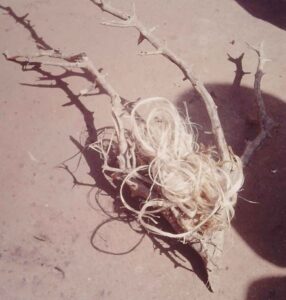
Die weiße Faser und der dambuuring Ast
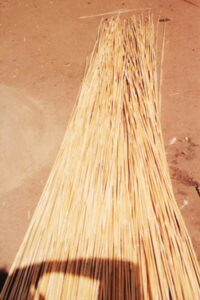
Ngmiena-Halme in Ajzong Yeri
2.3.7 Vorbereitungen zum Verbrennen der Köcher und anderer Waffen
Asiuk (fn 94,15a, 10.7.94, d.h. im Häuptlingsgehöft werden diese und folgende Riten, z.B. das Verbrennen des Köchers, am 4. Tag ausgeführt): Der Köcher wird aus dem dabiak von zwei Totengräbern, wie eine Matte getragen, auf ein Flachdachhaus im Innenhof gebracht und dort aufgehängt.
(fn 94,15a): Zwei Totengräber holen den Köcher vom Dach und bringen ihn in das Zimmer der Mutter des Häuptlings. Die Totengräber, die später den Köcher verbrennen, diskutieren in dem Zimmer. Außer diesen dürfen nur Vollwaisen den Raum betreten (Danlardy nicht, da seine Mutter noch lebt; ich hätte ihn betreten dürfen).
Ajuzong Yeri, Mutuensa, (88,272a+b), 27.4.89: In der Mitte des dabiak liegt ein dambuuring-Ast mit einer hellen Faser. Mit dem Holz werden Bogen und Köcher verbrannt. Daneben, am Grab, liegt ein Bündel loser Mattenhalme (siehe Foto). Im dalong bereiten Männer (Totengräber?) ein Bündel mit Köcher und Bogen vor. Alle Kinder werden vertrieben. Jemand holt ein sehr kleines Huhn, das unblutig getötet über die nanggaang-Mauer geworfen wird.
Information Danlardy Leander, 18.3.96: An dem Köcher befinden sich Äste des dambuuring-Baumes (Gardenia erubescens?).
Information Godfrey Achaw (fn 73,49b): Bogen und Pfeile werden nachts in viele kleine Teile zerhackt. Kinder, alte Frauen und Leute, die keine Geheimnisse bewahren können, dürfen nicht dabei sein (Auch Godfrey wurde es immer verboten). Eine Ziege wird von dem Ältesten, der den Bogen zerhackt hat, geopfert. Alle Personen, von denen beide oder ein Elternteil noch leben, dürfen von dem Fleisch nicht essen.
2.3.8 Opfer an den Köcher im dalong
Aduedem 2019: 27: …those two gravediggers who performed the log ritual enter [the compound] again, and removing the log from the gbong, they send it inside the dalong [ancestors’ room]. In there, they collect mwiena (straws of elephant grass), spread them and put the log on them, and the mwiena [ngmiena] are rolled around the log and tied with bog pielung [white fibre]. Another man comes into the dalong, sits [down] by the entrance and blows whistles while the daughter in-law (if her father is dead and his final funeral rites were performed, otherwise a different woman steps in for her at this time) uses mwiena again, lights fire and that fire brightens the room for the rituals in the dalong. The TZ, yam, rice, cake (kuosa, koosa), bumbota, etc. that are prepared (the second time) are used to sacrifice on the log in the dalong. Let it be noted that no one whose father is alive or dead but the final funeral rites are not yet performed is allowed to see the log kaabka (sacrifice on the log). Again, as the food is cut and put on the log, the nuri mwan [ngman] ka nuri mwan ka [the man is no longer there…] is repeated.
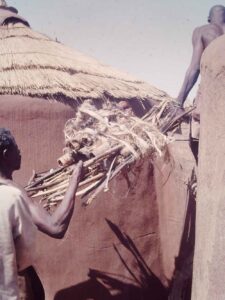
Ajuzong Yeri: Bogen und Köcher werden hinausgetragen
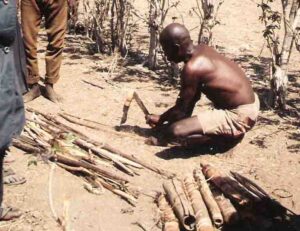
Ajuzong Yeri: Zerhacken eines Bogens
2.3.9 Heraustragen der Waffen
Asiuk (fn 94,15b, unter 4. Tag): Asiuks Köcher wird aus dem Zimmer von zwei Männern wie eine Bahre getragen und vor das Gehöft gebracht. Männer tanzen in Alltagskleidung eine Art Kriegstanz mit Stöcken. Die Frauen weinen, denn dieses ist der letzte Abschied von dem Toten.
Ajuzong Yeri, Mutuensa, (fn 88,272b): Nach 9 Uhr morgens tragen zwei Männer ein mit einer hellen kazagsa-Faser umwickeltes Bündel mit etwa 10 Köchern mit Pfeilen und 10 Bögen wie eine Bahre heraus. Das Bündel ist mit einer hellen kazagsa-Faser umwickelt. Einige weinende Frauen folgen dem Köcher (siehe Foto). Dies ist der letzte Abschied vom Toten.
Aduedem 2019: 27: When the sacrifice is finished, two people carry the log out while someone remains in the dalong watching the leftover food. As the two people move out with the log, the relatives of the deceased follow, mourning and wailing.
2.3.10 Zerhacken und Verbrennen der Waffen (lokta juka)
Mit dem Verbrennen der Waffen zieht die Seele der Toten in ein fest lokalisiertes Totenreich. Für die Atuga-bisa, den größten Teil der Bulsa, wird es Ajiroa genannt. Es liegt in der Nähe von Chana (siehe Anhang 6.4). Nach U. Blanc werden die Dinge (Waffen und Töpfe) durch ihre Zerstörung den Toten zurückgegeben.
Asiuk: Der Köcher, der beim bui des Häuptlings im Viehhof mit der Axt (liak) in kleine Stücke zerhackt wurde (lok cheka), wird verbrannt. Danach finden Begrüßungen im kusung statt,
Ajuzong Yeri, Mutuensa (fn 88,272a+b): Die Totengräber tragen Köcher und Bögen, die zum Teil Blutspuren aufweisen, hinter den tampoi, wo sie die kazagsa-Schnur lösen und die Köcher mit der Rückseite eines “Hackenbeils” zerschlagen. Die Bögen halbieren sie mit der Beilklinge auf einer Holzunterlage (siehe Foto). Alle Teile werden restlos verbrannt. Als Entlöhnung für ihre Tätigkeit haben sie von den Witwen je eine Kalebasse mit Fisch bekommen.
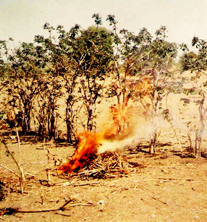
Ajuzong Yeri: Bögen und Köcher werden verbrannt
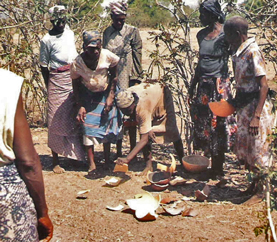
Ajuzong Yeri: Topfzerstörungen vor dem Gehöft
Information Ayomo Ayuali (fn 1994,50): Sein Großvater hatte zwei Köcher. Der beim Juka-funeral verbrannte Köcher wurde außer bei Kriegstänzen nie gebraucht; er wurde schon für das spätere funeral hergestellt. Der zweite Köcher wird heute noch von Ayomo bei Kriegstänzen benutzt. Der Bogen von Ayomos VaVa ist nicht im Gehöft, nur der des Vaters (Gründe?).
Information Danlardy, 17.4.96 (fn 94,87*): Auch Anyenangdu hatte zwei Köcher, nur einer wird bei der Juka verbrannt.
Information Yaw (fn 97,38b): Der Köcher wird vor dem Verbrennen einmal umgedreht (tulim). Daher wird der Tag auch lok-tulimka dai genannt. Das Verbrennen findet immer am na-vuuk (Viehdrift) vor dem Gehöft statt. Vor der Zerstörung wird über Köcher und Keramiktöpfe zusammen ein Huhn und ein Perlhuhn getötet. Zwei Männer halten das Huhn und ein dritter schneidet es in der Mitte (nicht am Hals!) mit dem Messer durch. Viele ekeln sich über diese grausame (wicked) Art ein Huhn zu töten. Sie laufen fort oder schauen weg. Wer zuschaut wird blind. Der Name des Rituals ist bantika (Abschied nehmen). Vgl. kpiak gebika: 3.4.1.2 und 3.7.2.1 (ngarika).
Aduedem 2019: 27f: When they get to the kraal, they put the log by the bui and cut it (the log) together with the dambuuring into pieces, and the woman who set the fire in the dalong brings that fire and it is used to set the pieces of the log on fire [Endnote 106]. It is only at this point of burning the quiver (log) and bow (tom) or in the case of a woman, the destruction of the puuk that the soul of the dead is released and can now properly enter the land of the dead [Endnote 107]. These rituals of destruction evoke strong emotional outbursts of close relatives because only then have they finally lost their relatives [Endnote 108].
When the fire is about dying down, the two gravediggers tell the sons of the deceased to put out the fire burning their father’s quiver. The sons bring a pot of pito and a hoe blade and these are put aside. The daughter in law (or the woman who stepped in for her depending on whether her father is alive or not) who set the fire in the dalong also brings another pot of pito and water. The two gravediggers taking her pito and the water, pour them into a calabash. All those present in the kraal using their left hands, fetch the content (pito and water) in the calabash and wash their faces (to wipe aware the tears from the crying) while moving around the burning quiver. The rest of that pito is poured on the fire and the hoe blade is thrown into it (the fire or perhaps ashes by then), saying they are quenching the fire burning their father’s quiver.
J. Agalic, Magisterarbeit (fn 88,4a): The eldest son performs the lok-cheka. After that the food is shared. The arrows are distributed among the sons of the deceased.
U. Blanc (2000: 222): Beim Juka für einen Mann werden Köcher, Bogen sowie Pfeile zerbrochen und verbrannt.
2.3.11 Topfzerstörungen vor dem Gehöft
Mutuensa, Ajuzong Yeri, (fn 88,272b): Frauen bringen einen bimbili-Topf und eine (zwei?) Kalebasse(n) an eine Stelle hinter den an den Köchern arbeitenden Totengräbern. Alle Gefäße werden auf dem Boden zerschlagen. Dies Ritual wird für die Frauen, die als “daughters of the house” (yeri lieba) nicht in einem fremden Gehöft starben, auf der Männerseite des Gehöfts ausgeübt (siehe Foto).
2.3.12 Kriegstanz in Alltagskleidung und “Erstürumung” des tampoi
Asiuk (nach Informationen von Danlardy Leander): Schon während des Heraustragens der Köcher aus dem Gehöft tanzen junge Männer in Alltagskleidung einen Kriegstanz mit einfachen Stöcken. Nach dem Heraustragen erstürmen alle dreimal den Abfallhaufen (tampoi) [Aussage unsicher].
Ajuzong Yeri, Mutuensa (fn 88,272b): Noch vor Abschluss der Waffenverbrennung läuft ein ca. 15jähriger Junge mit einem zangi-Gabelpfosten um das Gehöft. Ihm folgen Jungen und Mädchen in wildem Geschrei. Sie tragen Stöcke, zanga (Gabelpfosten) und dalta (Dachsparren). Dann läuft ein Junge auf den hohen tampoi und alle anderen ihm nach. So wird der tampoi mehrmals “erstürmt”. Auch Mädchen formieren sich in Kriegstanzgruppen, die alle mehrmals um das Haus ziehen. Gästen gegenüber (auch F.K.) zeigen die Gruppen eine rituell vorgespielte, aggressive Haltung, indem sie drohend auf diese zulaufen und dann wieder abziehen.
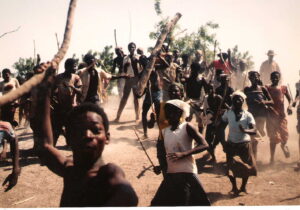
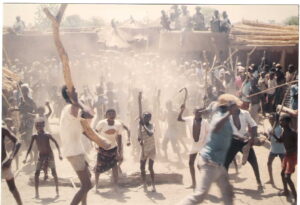
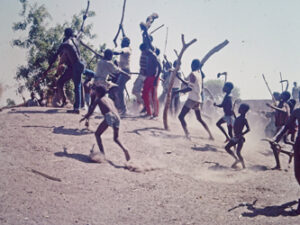 “Erstürmung” des tampoi in Wiaga-Mutuensa
Aduedem 2019: 28: As the fire is burning, the sons of the deceased continue wailing and performing a war dance (lielik) since [while the?] fire is burning their father’s quiver. This fire burning is also viewed in the form of natural fire disaster and that is why they perform the war dance as sign of their readiness to rescue their father’s quiver.
Atuick 2020: 91: …(Atuick: Fourth day) This is followed by war dancing over the remains of the louk by all who consider themselves children of the deceased man, including the cheri-deiroa.
2.3.13 Verbrennen der Mattenhalme
Ajuzong Yeri, Mutuensa, (fn 88,272a+b): Man holt mich in das Haus. Im Dalong brennt noch ein kleines Feuer. Es werden dort die Mattenhalme verbrannt, die schon am ganzen Morgen lose im Innenhof neben dem Grab des Toten lagen (siehe auch 2..3.8).
2.3.14 Puuta-mobika oder puuta cheka (Zerstören der puuk-Töpfe)
Ajuzong Yeri, Mutuensa, (fn 88,273a), gegen 11 Uhr: Am Hauptweg, der nach Yisobsa, Chiok und Badomsa führt, finden die Zerstörungsrituale für die Gefäße der Frauen statt, die in dem Trauerhaus als Ehefrauen gestorben sind.
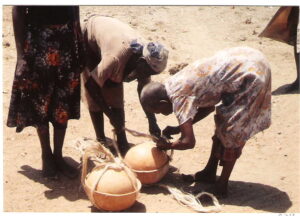
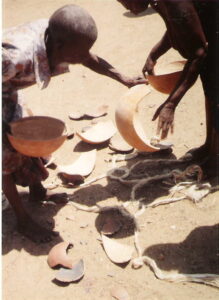
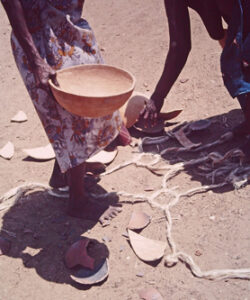
Mutuensa: Zerstörung der Kalebassen und Tontöpfe der verstorbenen Ehefrauen
11 Uhr: Drei Frauen (aus Yisobsa, Chiok und Badomsa) bringen zwei mit weißen kazagsa-Fasern verschnürte Doppelkalebassen (Basiskalebasse und Deckel) für die verstorbene Frau aus Yisobsa zum Weg. Vor dem Öffnen der Verschnürung klopft die Frau aus Yisobsa viermal an die oberer Kalebasse. In den Kalebassen befindet sich ein kpaam-kabook (Tongefäß für Schibutter, hier mit viereckigem Deckel, siehe Fotos. Das Gefäß wird auch von einigen Informanten puuk genannt, während man meistens unter puuk einen Noppentopf versteht). Die Frauen zerbrechen die unteren Kalebassen (zum Teil mit den Füßen) am Wege und bringen die heilen Deckel mit den Tontöpfen wieder in das Gehöft.
11.35 Uhr: Dieselben Frauen zerstören die Gefäße für die verstorbene Frau aus Atana Yeri (Chiok), etwas hinter der ersten Zerstörungsstelle. In dem kpaam-kabook befindet sich getrocknetes Hühnerfleisch, getrockneter Fisch u.a. Der leere Tontopf wird aus ca. 1/2 m Höhe mit Schwung auf die Erde geworfen und zerbricht. Die heile, kleinere Kalebasse wird mit den Nahrungsmitteln zurück ins Haus getragen.
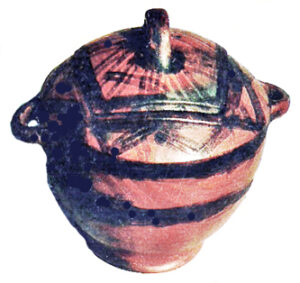
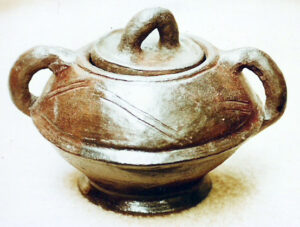
Fotos: Verschiedene Formen des kpaam-kabook (puuk)
12.00 Uhr (fn 88,273b): Dasselbe Ritual wird für die Frau aus Badomsa ausgeführt: Auch hier wird vor dem Öffnen des Kalebassenbündels viermal an die Kalebasse geklopft. Der Tontopf hat keinen Inhalt. Diesmal schlägt eine Frau ihn auf den Boden. Ebenso geschieht es mit der größeren Kalebasse, aus der nur ein Stück herausbricht. Um 12.20 Uhr sind die Topf-Rituale (puuta mobika) beendet.
Ayoling Yeri, Wiaga-Badomsa (fn 88,197b), nur von Asik Yeri aus am 28.1.89 beobachtet: Anurkas jüngerer Bruder Abarimi starb genau 5 Tage nach Leander: Puuta mobika: Eine Frau trägt puuk-Topf fort. Zwischen den beiden kusungta stehen mehrere große Töpfe.
Eigene Beobachtung und Information Baba aus Sandema-Kobdem (fn 1984,27a+b): An der Hinterseite von Awaribe Yeri (Regengott-Haus, Kobdem) stehen 2 x 5 Tontöpfe gestapelt. Für beide Stapel trifft die folgende Reihenfolge von unten nach oben zu: samoaning – bimbili – kpalabik – kaam-soluk – cheng. Vom linken Stapel sind die beiden oberen Töpfe herabgefallen, aber keiner darf die Töpfe berühren außer Totengräber (vayaasa) oder ein Witwer, wenn das Funeral seiner Frau schon abgehalten wurde. Die Töpfe gehören Atinpilie (Frau meines watchman), deren funeral von dem nah verwandten Nachbarhaus geholt wurde. Die zweite Frau ist Apoaliba, die Mutter des yeri nyono. Nur sie hat in dem dok (Zimmer, Quartier) gewohnt, an dessen Außenmauer die Töpfe stehen. Die Töpfe sind nur ein Teil des Hausrates der Frauen, die anderen Töpfe werden weiter im Haus benutzt. Auch Kalebassen werden am Wege mit Händen oder Füßen zerstört. Im puuk-Ritual des Juka-funerals werden die Töpfe von vier Frauen gehalten und zu dem Weg gebracht, der zum Elternhaus der jeweiligen Frau führt (hier Kandem und Wiaga). Sie lassen (jeweils einen?) Topf zur gleichen Zeit los. Wenn er auf dem Weg nicht zerbricht, ist es ein schlechtes Zeichen, d.h. es wurde etwas falsch gemacht oder die Tote ist verärgert, weil man etwas vergessen hat. Die Scherben werden beiseite geschoben, sie haben keine Bedeutung mehr.
Information Atoaling Anueka und eigene Beobachtung (fn 84,0b, auch 84,23a): In Anueka-Yeri (Sandema-Yongsa) stehen drei übereinander gestapelte samoaning Töpfe von Abiako’s Frau (Anuekas Mutter) im Viehhof an der Außenmauer. Sie sollten eigentlich außerhalb des Gehöfts an der Außenmauer stehen, aber diese ist eingebrochen. Die Töpfe werden beim Juka-funeral der Frau zerstört. Anders als in Kobdem besteht kein Berührverbot.
Information Margaret Arnheim (Gbedema) 1978ff (fn M5b+34a): Mehrere Töpfe werden auf dem Fußpfad zum elterlichen Gehöft der verstorbenen Frau zerbrochen. Es sind keine typischen Kochtöpfe. Auf den Scherben tanzen nur Leute aus der eigenen Sektion (?). Margaret hätte bei diesem Ritual im Gehöft des Gbedema Chiefs tanzen können. – Beim Topftanz ist auch die imitierende Frau anwesend.
Information Agoabe (Anamogsis Sohn) zur Juka (wessen?) in Anyenangdu Yeri: Zerstörungen fanden am 7. Tag statt (Zählung wohl einschließlich der Ruhetage). Esi und Achiilie (eingeheiratete Ehefrauen von Anamogsis Söhnen) zerbrachen die Kalebassen und Töpfe, die die toten Frauen zu Lebzeiten gebraucht hatten. Einige der Gefäße waren ihnen von Schwiegertöchtern gegeben worden. Die Kalebassen und Tontöpfe werden sanlengsa genannt.
Information Yaw (fn 97,38b): Nach Yaw wird ein Noppentopf (puuk) zerstört. Hiernach ist die Verstorbene eine echte Ahnin.
Information Danlardy (fn 97,61b*): Man zerstört nur die Töpfer älterer verheirateter Frauen, nicht die von jungen Frauen.
Information Sandford aus Kadema-Kpikpoluk (fn 73,161b): Bei dem Funeral einer Frau, die Kinder geboren hat, wird an der Kreuzung von wichtigen Fußpfaden ein Noppentopf zerbrochen. Die Scherben bleiben dort liegen. Ein neuer Noppentopf wird mit Blättern und Wurzeln bereitgestellt. Diesem wird später geopfert.
U. Blanc (2000: 222): Frauen aus der Herkunftssektion der toten Frau zerbrechen ihre Töpfe auf dem Weg zum elterlichen Gehöft.
Atuick 2020: 91: However, the juka rites of a woman are much more complex, with the cheri-deiroa playing a much more influential role. In this case, women from the paternal home of the deceased mother-in-law must arrive in the evening of the third day of the rites to sleep over. They usually come along with their own puuk [a ball-like ceramic vessel with a lid that symbolizes the womb of a woman during funeral performances] to participate in the rites. The wives in the compound, as a group, must acquire a puuk for the rites to commence. The cheri-deiroa must also acquire a puuk for the rites. The next morning, on the fourth and final day of the rites, the visiting women will take their puuk to the san-yigma’s compound to hand it over to him and ask him to help them present it to the husbands of their sister(s). The san-yigma then leads them to the compound where the deceased lived, exchanges pleasantries with the elders, and hands over the puuk to them after making the following statement: “As our daughter is preparing to go home, this is something that belongs to her that we have brought for her to take along with her.” The family collects it, after which some women from the compound sponsoring the funeral go to the compound of the san-yigma with their own puuk, flour, and meat from both the animal killed and a guinea fowl, for the preparation of the saab for the performance of the rites. They prepare the saab there and place it in clay bowls before carrying the food and the puuk towards the funeral house. Before they get to the funeral house, they wait at a distance from the compound.
(p. 92) The following day, all three puusa [plural of puuk] are taken back to the same spot where the women met the previous day and broken into pieces, except for the puuk provided by women of the deceased person’s compound, which is handed over to the cheri-deiroa for keeping. Thus, the puuk provided by the women from the deceased’s paternal home and the one provided by the cheri-deiroa are both destroyed, but the one from the wives from the compound sponsoring the funeral is presented by the chilie to the cheri-deiroa as an inheritance from her deceased mother-in-law. Being the eldest son’s wife, the cheri-deiroa receives this puuk as the rightful inheritor of the deceased’s household and property, and she is expected to keep this until her own demise.
2.3.15 Tanz auf den Topfscherben
Information Margaret (Gbedema): Auf den Topfscherben wird getanzt, aber nur von Personen der eigenen Sektion; beim Topftanz ist auch die imitierende Frau anwesend.
2.3.16 Herstellung eines feinen, hellen Pulvers
Ajuzong Yeri, Mutuensa, (fn 88,273a), 11.30 Uhr: Etwas abseits vom Wege reibt eine Frau auf einem Schibutter-Reibstein einen weichen hellen Stein zu einem feinen Pulver (die Bedeutung ist unbekannt).
Ajuzong Yeri: Das Grab wird verputzt
2.3.17 Das Grab
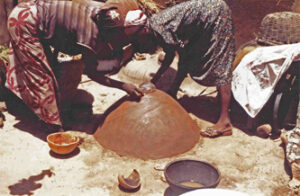
Während der Juka-Feier (meistens wohl am 3. Tag, nach Aduedem am ersten Tag) erhält der Grabdeckel des/der Verstorbenen durch Frauen einen endgültigen Verputz, heute meistens mit Zement-Beimischung. Am oder um das Grab werden Hirsekörner gestreut und zum Beispiel ein Huhn und ein Säugetier getötet (Diese Aktivität findet sich mitunter schon während der Kumsa-Feier, zum Beispiel bei Awuliimbas Kumsa). Die Tiere sind für den Verstorbenen gedacht, es sind aber keine echten Opfer.
Eine Zusammenfassung über alle Rituale und andere Aktivitäten am Grab nach der Bestattung findet sich im Teil 3.
2.3.18 Imitation des Verstorbenen durch eine Frau
Asiuk (fn 94,14a), eigen Beobachtung, 16.00 Uhr: Eine Frau (Akantoganyas Gattin; Schwiegertochter des Toten) in einem langen weißen Gewand, unter dem sich viele Amulette und Zaubermittel befinden, imitiert den verstorbenen Häuptling Asiuk (siehe Foto). Sie trägt Asiuks echte Sonnenbrille und seinen Stock. Solange sie die Zaubermittel trägt, darf sie kein Wort sprechen. Sie spielt den leicht Betrunkenen (Asiuk trank bei Festen viel) und den Störrischen (Asiuk wollte manchmal ein Haus nicht betreten). Sie wird stets begleitet von einer Frau in blauem smock mit blauer Mütze. Es ist der ngaang-viroa, der den Häuptling immer begleitet. Auch er ist verstorben, aber sein funeral wird hier nicht mit abgehalten.
Auch Awaab, ein Mann in europäischer Männerkleidung, begleitet die beiden Frauen. Er ist der chief messenger.
(fn 94,14b) 18.00 Uhr: Die Imitatorin hat ihr inneres Gewand ausgezogen und sie darf nun wieder sprechen.
2.3.19 Marktbesuch
Asiuk (fn 94,14a): Zwischen 17 und 18 Uhr: Eine Gruppe der Funeral-Teilnehmer zieht zum Markt: vorne 2 Sanduhrtrommeln, 2 Kalebassentrommeln und 3 Flöten; hinten 4 Zylindertrommeln und 6 namuning-Hörner. Die zwei Imitatorinnen, der amtierende Wiaga Chief von Accra, Ayabalie, die jüngste Tochter des Verstorbenen, Afulanpok, die jüngste Frau Asiuks, und zahlreiche Kinder ziehen mit (siehe Foto).
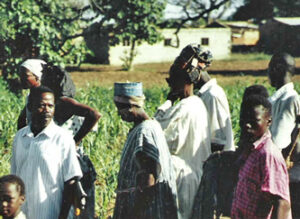
Asiuk: Zug zum Markt. In der Mitte die Imitatorin Asiuks
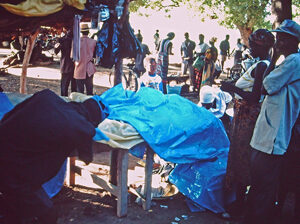
Marktstände wurden mit blauen Planen zugedeckt
Auf dem Markt dürfen alle Kinder ungestraft die Marktstände mit essbaren Waren plündern. Einige Verkäufer haben alle Waren mit blauen Plastikplanen verdeckt (siehe Foto), eine Gemischtwaren-Verkäuferin präsentiert ihre Waren unverdeckt, aber sie zeigt mir einen dicken Stock als Abschreckung für die Kinder [Endnote 109]. Unter dem Nimtree wird zum Spiel von Zylindertrommeln und Horntrompeten getanzt. Auf dem Rückweg zum Gehöft spielen zum Teil andere Hornbläser, denn bei einer Ermüdung der Spieler können sie ausgewechselt werden. Ein neues Musikstück beginnt zuerst mit Schlägen der Sanduhrtrommel, dann setzt die Kalebassentrommel ein, bis alle zusammenspielen.
2.3.20 Vergütungen der Dienstleistungen und Geschenke
Aduedem 2019: 28: The pito the sons brought earlier together with money (any amount, but the money is not compulsory, it is only a way of showing your social status/generosity/appreciation) is given to the gravediggers to use them and put out the fire. The rest walk out and the two men go inside the dalong to eat their food they left there. Some of the food is given to the one that blew the whistle, some to the woman who set the fire and some TZ is put into the ‘black’ calabash (chin sobli) and given to the woman to be given to the orphans (the biological children of the deceased) the following morning. That TZ is called kpingsa saab (orphans’ TZ).
2.4 Vierter Tag: Senlengsa dai (Doppelglocken-Tag) oder Daata nyuka dai (Tag des Pito-Trinkens), oder Kusung-puusika dai (day of greeting the elders)
Der letzte Tag der Juka ist der Tag von Menschenansammlungen, Tänzen und Musik, aber er ist arm an Ritualen (so auch U.Blanc).
Ich (F.K.) konnte an keinem Senlengsa dai das Geschehen des Tages selbst beobachten.
2.4.1 Hirsebrei (saab) für die Waisen
Aduedem 2019: 29: In the morning of this day, the [presiding] woman [chelie] takes the TZ (in the chin-sobli) she kept aside the previous night and sits [down] at the entrance of the dalong. Calling each of the biological children (from the oldest to the youngest), she cuts small of the TZ, scolds [Endnote 110] him/her and gives it to him/her to eat. She does that three times each for all the children. The scolding takes this form: “Nwua [ngoa], fi a kping ka nna, fi puom bagaa nya ka nna yeg-yega. Ka wana tim pa wa nganta a te fi a kping ka nna?” Thus, “take this, you [are] the orphans, you are even looking too much. Who will give food to orphans like you?”
2.4.2 Abschluss der Hirsebierbereitung, die am 1. Tag begonnen und Verteilung
Aduedem 2019: 29: Afterwards, the elders in the kusung dok sent two men inside to the presiding woman, to find out whether there is pito from the pito malt (kpaama) they gave her, in reference to the first day of the juka rites. The woman then calls the first son of the deceased and shows him the pito in the pots. The woman takes a pot of pito and the son takes calabashes (daam china – pito calabashes) and they sent them out to the elders saying: this is dirt of the deceased. Out of courtesy the elders would ask that some of the pito be given to the mothers-in-law (nga niima) of the deceased who have come to witness the funeral rites. However, the sons would opt to provide different pito for them (mothers-in-law). More pito may even be supplied and everyone drinks hence the DAATA NYUKA DAI (literally, drinks/pito drinking day) for this day. Thus, it is this day the pito (daam – meaning a [an alcoholic] drink) is drunk.
Azognab 2020: 51 (Information von Akaalie Aginteba, Sandema 2018): Damonung (‘Pito’) whose preparation would have started from day one of the juka ritual is provided for the elders. If the deceased person in question is a female or unmarried, the funeral ends with the greetings of the elders and the ‘pito’ party among them. On the other hand if the deceased person was a married man with a surviving wife or wives, this last day will also mark the day the widows or widow chooses a new husband…
2.4.3 Marktbesuch im Gehöft des Chiefs scheitert
Asiuk (Information durch Danlardy), 12.7.94 (Montag): Zur Zeit des Höhepunktes der Feier wollten die Töchter des verstorbenen Häuptlings zum Markt ziehen, um anzuzeigen, dass das Funeral erfolgreich abgehalten wurde. Vorher wurde der ganze Markt jedoch von aggressiven Bienenvölkern leergefegt, was so gedeutet wurde: Asiuk wollte den Markt für sich alleine haben. Der Verkauf wird danach an die Kreuzung (Goansa) verlegt. Vor Danlardys Haus (er ist ein Verwandter von Asiuk) werden Tänze aufgeführt. Dan spendiert 1 Flasche Akpeteshi und 1 Kalebasse Hirsewasser.
2.4.4 “Beopferung” der Gehöftmauer (Vergleiche 2.4.6: Parika kaabka bei Kumsa)
Aduedem 2019: 30: The sons also provide a fowl (chick) for the elders. And those [who were] responsible for sacrificing the wall [on the Kumsa, gbanta dai] use it to sacrifice the wall again. As they smear the blood on the wall, the say: “That is all, there is no funeral in this house again [any longer]”. And children may take the fowl and roast it.
Atuick 2020: 91: Following the war dancing, the eldest son of the deceased performs the final sacrifice of the rites on the left wall of the main entrance of the compound. While standing there, he gathers all the live fowls brought from the earlier visit to his late father’s mother’s lineage and those donated by friends and sympathizers to help him complete his father’s funeral rites, and sacrifices them on the wall. He does this by hitting the fowl, one by one, against the wall to die. While their blood flows down the wall he says, “Bak ko parik! Ti kowa kumu yai nueri kama!” [“They have killed a wall! Our father’s funeral is now over!”]. This sacrifice literally marks the end of the funeral rites for the deceased man, and by extension, the role of the cheri-deiroa. The next thing is for all the dead birds to be plucked and cooked for all present, including the cheri-deiroa, to eat to their satisfaction before dispersing.
Information Danlardy Leander (fn 1994,60b): Am letzten Tag der Juka werden kamsa-Kuchen an die Hauswand geschmiert (keine weiteren Bestätigungen!)
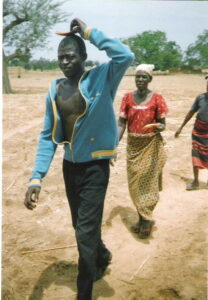
Adama tanzt den senlengsa-Tanz
2.4.5 Bemerkungen zum senlengsa-Tanz
Information Adama (Chiok) via Danlardy (fn 88,305b): Der senlengsa-Tanz fiel bei Asiuks funeral aus, da dieser Tanz nur für weibliche Tote stattfindet. Das Ritual existiert wahrscheinlich im ganzen Bulsaland. Danlardy hat Belege für: Chiok, Guuta, Yimonsa, Longsa, Wabilinsa, Kori, Kom, Siniensi, Fumbisi, Sandema, Wiesi, Kanjaga, Doninga, Chuchuliga.
Bei einer Juka-Feier in Chiok gab Adamas Schwester ihrem Bruder eine Scherbe von den zerstörten Kalebassen der Toten. Adama legte sie beim Tanz auf den Kopf.
Der Tanz drückt die Freude darüber aus “dass die Toten vertrieben wurden” Als Musikinstrumente werden dazu gespielt: ginggana (Zylindertrommeln), namunsa (Horntrompeten), gori (Kalebassentrommel), gunggong (Sanduhrtrommel), wiisa (Flöten). In Chiok hatte man gerade keine senleng-Doppelglocke zur Hand; daher nahm man eine Glasflasche und schlug mit einem Stock dagegen.
Information Yaw (fn 97, 38b): Wenn ein matrilinearer Verwandter teilnimmt, nimmt er sich eine Topfscherbe oder einen Splitter des Köchers, legt diese auf den Kopf und tanzt damit. Danach wirft er sie fort.
U. Blanc (2000:229-32, hier verkürzte Auszüge aus S. 229-30): Der Doppelglockentanz (senlengsa gokta) in Reihenformation wird nur von Frauen [für verstorbene Frauen] getanzt. Als Begleitung gibt es nur die Doppelglocke und Händeklatschen. Der Gesang ist reiner Chorgesang (ohne Vorsängerin). Meistens führt eine Tochter der Verstorbenen den Tanz an. Es können auch Jungen und Männer hinzutreten, wenn ihre Schwestern tanzen. Sie tanzen auf den Scherben der zerstörten Töpfe und balancieren Scherben der Töpfe auf dem Kopf, während sie auf das Elternhaus der Toten zu tanzen.
Der Tanz ist eine Ehrenbezeugung für ältere Ehefrauen, die lange im Gehöft gelebt und viele Kinder geboren haben. Senlengsa yiila gehören zu den kum-yiila (Totenliedern).
2.4.6 Naapierik ginggana (Tanz zum Aschenhaufen)
U. Blanc (2000: 221): Die kobisa des Toten sind für diesen Tanz verantwortlich. S. 223: Der Tanz… der Männer zum Aschehaufen beendet diese abschließende Phase der Juka.
(S. 227) Er entspricht dem sinlengsa-Tanz für eine tote Frau und ist eine Art Abschiedsgruß.
(S. 228:) Im Idealfall spielen 3-4 ginggana, aber keine anderen Instrumente. Nur erfahrene Männer (gute Sänger) dürfen in den reinen Chorgesang einstimmen. Der Reihentanz in langsamen, bedächtigen Schritten soll vom ältesten Sohn des Verstorbenen angeführt werden (evtl. Ersatz).
2.4.7 Zug zum Guuk des Gehöftes
Information Danlardy Leander 5.9.96: Am senlengsa dai zieht man bei der Feier von bedeutenden Männern zum Guuk des Gehöftes.
2.4.8 Wiederverheiratung der Witwen (nicht beobachtet)
Nach mehreren Sandema Informanten (Godfrey Achaw, Aduedem, Azognab…) findet die Wiederverheiratung erst am vierten Tag statt, in Wiaga mitunter jedoch auch schon am dritten Tag.
Siehe auch Kröger 1978: 291-94
Asiuk (fn 94,15b, Information durch Danlardy): Alle Witwen versammeln sich [am vierten Tag] im Raum der Häuptlingsmutter, und sie werden nacheinander gefragt, wen sie heiraten wollen. Fünf von ihnen heiraten das Grab des Häuptlings (ba yali naawa boosuku), d.h. sie leben weiter als Ehefrauen des Häuptlings. Später können sie trotzdem einen anderen Mann heiraten, ihre Kinder gehören dann auch dem neuen Gatten.
Anoalisikame (jüngste Witwe) heiratet den verstorbenen Albert Agoldem (dessen funeral noch nicht abgehalten wurde), Akanngarayuk (zweitjüngste Witwe) heiratet Owen Agoldem; Asebalanye (Clement´s Mutter, drittjüngste Witwe) heiratet Peter Anang, den ehemaligen katholischen Priester. Bis zur Bekanntgabe ihrer Heiratsentscheidungen müssen die Witwen Blätter tragen, danach können sie Stoffkleidung anlegen.
Ajuzong Yeri, Mutuensa, (88,273b), abends: Die Witwen tragen Blätterkleidung. Eigentlich dürften sie mit keinem Mann sprechen oder von keinem Mann berührt werden, denn dies gilt als Zustimmung zur Heirat, aber als ich mich unwissend bei einer Witwe für das Mittagessen mit Handschlag bedankte, gab es kein besonderes Aufsehen, nur etwas Gelächter.
Wenn eine Witwe zum 1. Mal zur Wahl aufgefordert wird, antwortet sie: “Nyiam diem tuila kama!” (Das Wasser ist noch nicht heiß; d.h. man möchte noch etwas warten). Dann wählt sie einen Mann, der ihr daraufhin ein Perlhuhn oder Geld gibt. Zwei (klassifikatorische) Schwestern (aus dem gleichen Gehöft) können (müssen?) denselben Mann heiraten, zwei in der Geburtenreihenfolge aufeinander folgende Schwestern (derselben Mutter?) dürfen dieses allerdings nicht.
Information Godfrey Achaw (fn 73,19b) Die Frauen des Vaters können von den Söhnen geheiratet werden, soweit es sich nicht um die leibliche Mutter handelt oder die Frau aus der gleichen Sektion wie die leibliche Mutter kommt.
(fn 73,33a): Eine Wiederverheiratung [F.K. Vollzug der Ehe?] kann erst am Tag nach der Beendigung der Totenfeier stattfinden. Eine Frau soll ihren neuen Gatten unter den Männern des Gehöfts ihres verstorbenen Mannes aussuchen oder in den vier verwandten Compounds [F.K. kobisa]. Wenn sie in die Sektion ihres Mannes heiraten will, verlässt sie nachts heimlich das Haus und geht sofort in das Haus ihres neuen Gatten (nicht zuerst in ihr Elternhaus). Das Haus wird nicht als Feind des alten Hauses angesehen. Der neue Gatte zahlt nichts an das alte Haus oder das Elternhaus der Frau, sondern informiert nur letzteres und die Verwandten des ersten Gatten. Es gibt keine erneuten Heiratsrituale. Wenn der erste Gatte das “gate” noch nicht geschlossen hat (nansiung lika), muss es der zweite Gatte tun (s. Kröger 1978: 374-76). Will die Witwe nicht in die Sektion ihres verstorbenen Mannes heiraten ohne schon eine neue Wahl getroffen zu haben, geht sie zuerst in ihr Elternhaus und der Bewerber kommt zu diesem Haus. Es finden alle Rituale und Zahlungen wie bei einer Erstheirat statt. Der neue Gatte wird ein Feind der Verwandten des ersten Gatten. die auch nicht informiert werden.
Information Leander Amoak (fn 79,2b + 8a): Nach dem Tod eines Gatten haben die Kinder der anderen Frauen einen ersten Anspruch auf die Ehefrauen ihres Vaters, da die neue Nachkommenschaft dem wen des Toten (Großvaters) opfern werden. Wenn ein Bruder des Verstorbenen die Witwe heiratet, werden die Kinder später dem wen des neuen Gatten (des Bruders) opfern. Leander hat Anspruch auf die Witwe seines verstorbenen Bruders Atiim, weil keine Kinder anderer Frauen da sind.
Information Agoabe (Sohn Anamogsis; E-mail 12.3.09, fn 08,B19): Die Wahl der Witwen Akanpaabadais (Anamogsis Sohn) wurde mit dem Bad der Witwen am tampoi verbunden. Vor dem Bad wurde eine gaasika (s.o.) durchgeführt. Die Leitung der Rituale hatten die Nachbarinnen Afulang aus Atuiri Yeri und Akansagba aus Adum Yeri (Badomsa). Während der Wahl saßen die Männer im kusung. Die Witwe nannte den Namen des Mannes, mit dem sie baden wollte.
Zur Juka (Akaayaabisas) wurden auch die Frauen des Verstorbenen eingeladen, die vor seinem Tode nicht mehr bei ihm wohnten oder einen anderen Mann geheiratet hatten. Ohne eine solche Einladung würden auch die Kinder dieser Frauen nicht mehr als Kinder des Verstorbenen angesehen.
E-mail 24.3.09 (fn 08,B19b): Eine Frau, die schon zweimal in einem Gehöft verheiratet war, darf nicht ein drittes Mal jemanden aus diesem Gehöft heiratet. Wohl darf sie weiterhin im Gehöft wohnen oder einen Mann aus einer fremden Lineage heiraten. Keiner aus dem Gehöft ihres verstorbenen Gatten ist offiziell verantwortlich für sie. Später werden wohl ihre Kinder für sie sorgen (ähnliche Information auch durch Yaw).
Information Yaw 2002 (ähnlich Danlardy 2004): Eine junge Witwe könnte sich einige Zeit nach dem Tode ihres Mannes schon mit einem neuen Partner verbinden, “da man ihr nicht zumuten kann oft mehrere Jahre bis zur Juka zu warten”. Bei der Juka wird sie dann diesen Partner als den gewählten Gatten angeben.
(fn 02,21b): Abiisis Totenfeier könnte jetzt (2002) vor oder nach der Juka Anyenangdus abgehalten werden. Sobald der Säugling Abiisis entwöhnt ist, könnte sich seine junge Frau schon wiederverheiraten, da man ihr nicht zumuten kann, bis zur Juka Abiisis zu warten. Man erwartete dann von ihr, dass sie sich einen Bruder ihres verstorbenen Mannes als neuen Gatten aussucht. Falls sie einen Mann aus einer anderen Sektion heiraten will, wird sie das Gehöft Anyenangdu Yeri verlassen.
2008: Bei der Wahl des Gatten können die Witwen auch sagen, dass sie einen bestimmten kleinen Jungen heiraten möchten. Eine solche Verbindung ist oder wird keine richtige Ehe, d.h. sie wohnen nicht zusammen. Ein Gehöftherr war sehr verärgert, dass viele jüngere, noch gebärfähige Ehefrauen ein Kind “geheiratet” hatten.
Wenn eine Witwe ein Kind von einem anderen Mann nach dem Tode ihre Mannes, aber vor der rituellen Wiederverheiratung geboren hat, so nennt man diese Geburt zukuusa. Wenn eine zukuusa-Frau, vor allem zwischen Kumsa und Juka, einen Kranken besucht, so wird dieser geheilt.
(2011, fn 1b): Nach dem Tod Anamogsis bemühten sich seine Söhne um ihre jüngeren Stiefmütter. Christliche Witwen lehnten es ab, die Frau eines verheirateten Mann zu werden.
Information Danlardy Leander (fn 02/04, 54*): Abiisis Brüder können seine Witwe nicht offiziell vor Abiisis Juka heiraten, aber doch mit ihr zusammenleben. Sie könnten sogar Kinder haben. Beim Juka-Funeral würde der Bruder sie dann offiziell als Ehefrau fordern.
Aduedem 2019: 29 …the elders send two men again to the presiding woman, telling her to ask the widow who she wants to get married to, since the funeral rites of the husband are over. The two men will do that four times. She can marry anyone from the extended family, and in the case of a polygamous marriage, she can even marry any of the sons of the co-wife (but never her own son), or she decides to remain unmarried by marrying the grave of the late husband [Endnote 111]. After the fourth round, the presiding woman comes to the elders and announces to the elders the name of the person she (the widow) wants to marry. This remarriage is a “ritual proper for the reintegration” of the widow into society and after this remarriage, the widow starts wearing her normal clothes again [Endnote 112].
The person she mentioned is called by the elders and he is asked to provide a basket of millet, a guinea fowl, pito and tobacco. When he has provided them, the elders call the presiding woman and give the items to her. Those items are for the presiding woman because the understanding is that, the widow is her daughter and she has just handed her daughter’s hand in marriage to the said husband.
Azognab 2020: 51-53 (Information von Akaalie Aginteba, Akanvarilami Ataasapo, Atgenglie Awurung, Adoruk Achumwari, alle Sandema 2018)
The Bulsa concept is that the widow or widower who shared [his/her life] with the deceased person in a very intimate way during their life time may want to take the spouse along for the companionship which they shared on earth and hence, it is only the widowhood rites that separate them. Connected to this is also the belief that their union in marriage is not broken by death but by the funeral celebration of the deceased person…
At this stage, the Bulsa believe the widow can then remarry on the final day of the juka ritual described earlier. The widow is usually subjected to pressure to choose her new husband from her husband’s family. Again the Bulsa believe the widowhood rites are necessary to purify the surviving spouse of the daung or daunta (mystical dirt) of the deceased person. This is necessary for re-integration.
p. 52-53: The widowhood ritual begins from day one when a spouse dies. As soon as he dies and the corpse is bathed and laid in the dalong, the widow is separated and sent to another room where other elderly women as consolers and supporters stay with her to guide her and provide her needs. She remains in that room till burial takes place. This separation continues until the final funeral rites are performed and the widow is re-integrated. If the final funeral rites are waited for long, the widow may be free after some period of time to go about her usual duties, but she is forbidden to marry until the final funeral rituals are completed. A widower, on the other hand, sits outside and is surrounded by his friends from the community who make sure they give him the support that he needs…
Throughout the dry funeral celebration of her husband, the widow wears only vaata (literally, leaves) and sits on Shea nut leaves in a confined room. A widower on the other hand sits on the skin of a cow.
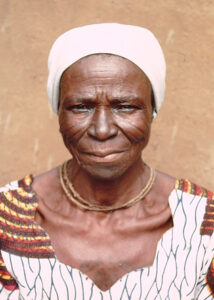
Asiuks Witwe mit einer Witwen-Halsschnur
2.4.9 Ablegen der Körperschnüre (miisa folika) und 2. Kopfrasur
Ajuzong Yeri, Mutuensa (fn 88,270b): Viele Frauen tragen 2 oder 3 gedrehte Kordeln schärpenhaft über die Schultern. Diese sind nahe Verwandte des Toten, die bei der Kumsa mit Daluk beschmiert waren. Viele tragen sie nach einer Information als Hüftschnüre (von außen unsichtbar). Die Schnüre werden am Ende der Juka-Feier mit einem Stein auf einem Fußpfad in kleine Stücke zerhackt.
Information Danlardy Leander (fn 1994,80*): Die jom-suiroa (su: to put on, anlegen, Verbalnomen: jom-suka) entfernt und zerschneidet die Witwenschnüre ohne begleitende Riten und Tabus. Nach dessen miisa folika genannten Ritual können Witwen heiraten (Ehe mit dem gewählten Gatten ausüben?).
Die jom-suiroa-Frau wird sogleich nach dem Tod eines Mannes (Gatten) bestimmt und hat danach mehrere Aufgaben zu erfüllen. Gleich nach dem Tod hat sie den Witwen die Schnüre angelegt (Handlung: jom-sugka) und hat die Witwen gebadet (s.o.; fn 1994,82).
Die Schnüre werden (heutzutage) vor dem miisa folika Ritual nicht immer getragen, sondern, zum Beispiel von Danlardys Müttern in ihren Schlafzimmern unter Deckenbalken aufbewahrt.
.Die Halsschnur muss wenigstens einen Knoten haben, die andere Knoten dienen der Anpassung [der Länge?].
Information Asiuks Witwe, Clements Mutter (fn 94,74b): Sie trägt wie alle Witwen, eine aus kazagsa-Fasern gedrehte Schnur (miik) um den Hals, um die linke Hand und um den linken Fuß. Alle Schnüre enden in einer Doppelschnur mit 3-4 Knoten.
Aduedem 2019: 30f: One week later [after the Juka Funeral], the widow cooks Bambara beans (suma) and makes cakes (kamsa), and the man who shaved her (on the nyaata soka dai) is invited. He comes and shaves her again and after that, he removes the ropes she wore as beads [necklace?] during the whole funeral rites performance. No one is supposed to see those ropes, so he buries them in the tampoi (rubbish heap). The widow then serves the man some of the Bambara beans and the cake (kamsa). After eating, the man thanks the widow and tells her that the man she chose is duly her husband thereafter and he goes to his house. Everything has therefore come to an end.
p. 32: [The widow is shaved] on the jueta soka dai and a week after the kusung puusika dai. All these [rites] are to cleanse her of the old life as a wife to the deceased. Thus, when the final funeral rites have been performed, the surviving spouse no longer belongs to the deceased, she/he starts a new beginning altogether, and that is why in the case of a widow, she can marry again.
2.4.10 Kaolin tika (das Geben von Gütern, Erbschaft)
Nach Abschluss der Juka werden Hinterlassenschaften des/der Toten zusammengestellt und an die Erben verteilt.
Information Yaw und Aleeti (fn 01,2b): Der nächstälteste Bruder des Verstorbenen erbt sofort nach dem Tod alle wichtigen und wertvollen Dinge, da er die Mittel braucht um die Totenfeier zu finanzieren. Falls er sich weigert, die Feier auszuführen, erbt er gar nichts. Persönliche Dinge des Verstorbenen (zum Beispiel Bücher) gehen an die Kinder des Verstorbenen, persönliche Dinge einer verstorbenen Frau, zum Beispiel eine Nähmaschine, erhält eine ihrer Töchter. Anamogsis ältester Sohn Asuebisa erbt nichts, da er [als Christ?] die Totenfeier nicht ausführen will.
Siehe auch Kröger 1982: 64-77 (Ancestor Worship…)
Information Asage aus Adum Yeri, Badomsa (fn 81,16b,) Verhinderte Erbschaft und Nachfolge: Als Ajogyam, ein Enkel von Abadomgbana, Erdherr (teng nyono) von Badomsa war, wollte er die Totenfeiern von zwei Ahnen abhalten, durch die er wohl auch Elder (kpagi) von ganz Badomsa geworden wäre. Eine Gruppe von Elders verhinderte diese Funerals, um eine zu starke Machtkonzentration in einer Hand zu verhindern. Auch heute noch können die Nachkommen von Abadomgbana nie (ohne die Abhaltung der genannten Funerals) das wen des Sektionsgründers Abadomings erwerben, während das Amt des Erdherren nur unter den Nachkommen von Abadomgbana rotiert.
Information Godfrey Achaw (fn 73,19b): Erbschaft eines Mannes: Das Land, das vor dem Gehöft liegt, d.h. das er von seinem Großvater ererbt hat, geht ebenso wie das ganze Gehöft an den ältesten Bruder des verstorbenen Gehöftherrn, alles andere Land bekommt der älteste Sohn [F.K.: Aussage ungenau und unwahrscheinlich]. Vieh, das er ererbt hat, geht an den ältesten Bruder. Das zu seinen Lebzeiten erworbene Vieh geht an seinen ältesten Sohn. Wenn der älteste Sohn von dem ererbten Gut etwas verkauft, muss er den Erlös mit seinen Brüdern teilen.
Aduedem 2019: 30: If the deceased was a landlord, the elders will call all those concerned (from the house) to the kusung dok and tell the sons that their father is no longer there, therefore, the next landlord is Mr “A”, “B” or “C”.
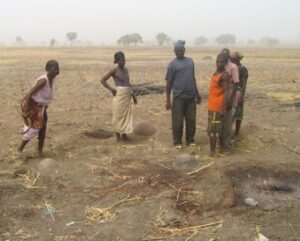
Agaab Yeri, Chantiinsa
3 Exkurs (Zusammenfassung): Das Grab und die Grabschale
Das Grab des oder der Verstorbenen spielt bei den Kumsa und Juka Feiern keine so große Rolle wie etwa die Totenmatte in der Kumsa oder Bogen und Köcher in der Juka Feier. Die Art der Aktivitäten am Grab und ihre zeitliche Einordnung scheinen im Bulsaland zu variieren. Tieropfer, bei denen das Blut über die Grabschale geschüttete wird, gibt es wohl nirgendwo, wenn auch mitunter (s. Awuliimba) ein Huhn am Grab des Verstorbenen unblutig getötet wird. Am verbreitetsten ist wohl das Niederlegen von einigen Hirsekörnern am Grab (Sollen sie als Saatgut einen neu beginnenden Ackerbau im Totenreich ermöglichen?). Die Grabgaben (Hirsekörner, Bohnenkuchen, Bohnenspeise) entsprechen auch nicht den Opferspeisen an einen wen-Schrein, sondern ähneln eher den Nahrungsmitteln, die man vor den Totenfeiern der Seele (in der Totenmatte) schenkt.
Wenn auch von mir beobachtet wurde, dass die Grabschale schon in der Kumsa-Feier ganz grob (und vorläufig?) mit nassen Lehmballen verputzt wurde, so erhält sie doch erst in der Juka-Feier ihren dauerhaften und endgültigen Verputz (in neuerer Zeit sogar durch eine Zement-Sand Mischung). Das “Luftloch” in der Schale kann jetzt auch durch feuchten Putz verschlossen wurde, denn die Seele erhält ja nun einen neuen Aufenthaltsort im Totenreich.
Awuliimba, Sandema-Kalijiisa, Kumsa (fn 88,226a), 10.3.89: Am Grab Awulimbas wird ein Huhn von einem Totengräber durch Schlagen auf den Boden getötet. Auf das Grab wird etwas Hirse gelegt.
Acha Yeri, Sandema-Chariba, Kumsa: Im Innenhof sitzen die Totengräber neben dem Grab. Leute geben den Totengräbern (dem Grab?) Geld. Es liegt dort ein Bündel mit 100 und 200 Cedi Scheinen.
Adiita Yeri, Wiaga-Yisobsa-Guuta, Kumsa, 12.51 Uhr (nach der parik kaabka): Zwei Frauen verputzen das Grab des Toten hinter dem Gehöft in einer groben Weise, indem sie nasse Tonballen über die Schale legen und leicht verstreichen.
Agaab Yeri, Wiaga-Yisobsa-Chantiinsa, Kumsa, 14.28 Uhr: Zwei Gräber abseits des Gehöfts (ca. 50 m) werden von ca. 8 Frauen verputzt.
Asebkame Yeri, Wiaga-Chiok (fn 88, 120b): Der Zug zum Grab muss ausfallen.
Ajuzong Yeri, Mutuensa, (lokta juka dai) Um 8.30 Uhr geht eine Frau mit einer großen Kalebasse voller Hirsekolben zum Mörser. Daraus wird Hirsebrei für die Frauen gekocht, die das Grab verputzen.
(fn 88,273b): 12.20 Uhr: Im “Chiok-Innenhof” ist schon ein Grab ganz verputzt und trocknet inzwischen. Das andere Grab ist verputzt und eine Frau bemalt es mit daluk (Foto siehe unter 2.3.17).
Information Godfrey Achaw, fn 73,48b: Am dritten Tag der Juka-Feier opfern [?] die Frauen Hirsebrei und Bohnenkuchen über dem Grab des Toten (auch die Bohnenspeise mit viel Öl wurde bei der Kumsa von Frauen am Grab geopfert).
Information Danlardy Leander (17.4.96): In Wiaga werden Gräber nie beopfert.
Information durch R. Schott (Juka): Töchter des Hauses bringen saab + zom dem Grab dar. Für Männer ist die Teilnahme streng verboten.
Atuick 2020: 88f: (Ausgeführt am Gbanta dai der Kumsa): Moreover, on this final day, the grave of the deceased is plastered as part of the funeral rites and the cheri-deiroa again has a role to play there. The male kobiik leading the funeral will send a message to the female chilie to send the cheri-deiroa to them to help put the grave in shape. Subsequently, the chilie, with the support of her assistants, must take water and sand to the grave side for the plastering. Before plastering, sand is fetched and thrown on the grave of a man three times or that of a woman four times and each time that is done, the cheri-deiroa must clear the sand from the grave as a sign of her readiness to protect her parent-in-law from harm. This segment of the cheri-deka ritual is done for every family member whose funeral is being performed regardless of the age at which they died.
Aduedem 2019: 22f: (Vergleiche hierzu 2.1.1: Elders in the kusung am 1. Tag der Juka):The sons/relatives provide tobacco (tabi), a fowl and an animal… which are taken together with some of the millets from the two baskets to the grave by the gravediggers for the vorup chiesika rituals. At the grave, they thrash (piag) some of the millet and use the grains to put all round the grave. Then the fowl and the animal are sacrificed similarly to what was done during the burial rituals. These are gifts given to the deceased as he goes to kpilung – home of the dead.
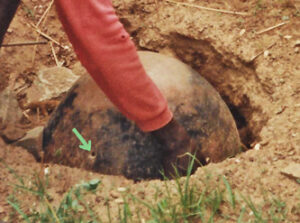
Die abgesunkene Grabschale von Leanders Grab. Der grüne Pfeil weist auf das Luftloch.
Die Grabschale nach den Totenfeiern:
Leanders Grabdeckel ist abgesunken 1994 (fn 94,6b): Asaaluk und ein Bruder Akais, der aus Kumasi zurückgekehrt war, waren Leanders Totengräber. Gewöhnlich zeigt man einem Freund des Toten dessen Grab nicht (Nach Leander, fn 94,35b, darf er es erst 4 Jahre nach dem Tode sehen). Bevor wir zum Grab gehen, müssen wir uns die Schuhe ausziehen. Asaaluk kratzt mit der Hacke den Boden frei, obwohl es hier überhaupt keine Unkräuter gibt. Die Tonschale (boosuk) ist nur halb sichtbar, sie ist in den Boden gesunken. Daneben liegt ein sehr alter Grabstock ohne Klinge und ein sehr alter Hackengriff. Wir müssten eigentlich noch eine Libation gießen, aber Ayomo kann keinen Akpeteshi in Badomsa kaufen. Die Hebung des Grabdeckels soll später erfolgen, man diskutiert aber auch noch die Umbettung des Toten in das Innere des Gehöfts.
Anamogsi u.a. verputzen Grab Anyenangdus (fn 08,11b): Er formt aus angerührtem Lehm lose Ballen und klatscht sie in kreisförmigen Lagen auf die Tonschale, von der man den alten Verputz entfernt hatte. Dann wird der Putz der Schale verstrichen. Inzwischen rühren Ajadoklie und Abasi Zement an, der mit grobem und feinem Sand vermischt wird. Zuerst werden einige persönliche wen-bogluta verputzt, aber nicht solche, die frische Opferspuren tragen. Dann wird der Zementputz von Frauen auf den nassen Lehmputz aufgetragen und mit einer Topfscherbe und einem Kieselstein poliert. Abasi soll mit einer Spiralfeder ein Muster eindrücken, aber sie macht es mehrmals falsch, denn es soll ein Fischgrätenmuster werden. Achioklie greift ein. Später schreibt Yaw noch ANYENANGDU in den nassen Zementputz.
Information Margaret Arnheim 1978ff (fn M30a): Die Grabschalen werden nur im Innenhof mit Lehm verschmiert, vor dem Gehöft sieht man die unverputzte Tonschale. Gräber sinken oft ab. Im Innenhof schlafen Menschen zwischen den Gräbern, vor einem Friedhof habe aber fast alle Angst.
(fn M34a): Nach Auskunft des inzwischen verstorbenen Adizuak aus Gbedema-Gbinaansa und Informanten aus Gbedema Kunkoak hört man mitunter den Satz: “N dan kan yuen ale kpi n boosuk ale na”. – ‘If I do not speak (= confess) and die, my boosuk will crack’.
Wenn zum Beispiel die Mattenbefragung (noai-boka) ergab, dass der Tote selbst an seinem Tode schuldig war, ohne dass erkannt wurde, dass er kabong [Ehebruch] begangen hatte, dann hätte er eigentlich mit diesen “Problemen” (mit dieser Schuld) nicht begraben werden dürfen. Dies geschieht oft in Eile, wenn die Leiche schon anfängt zu riechen. In einem solchen Fall kann die Grabschale zerbrechen.
Ein Loch wurde vor der Bestattung in die Grabschale gebrochen oder gekratzt, damit die Seele in der Ngomsika (Juka) Feier entweichen kann, um in das Totenreich zu ziehen. Danach kann die Schale verputzt werden und das Loch verschlossen werden.
Information Ansoateng (Wiaga-Badomsa) Wenn ein keramischer Grabdeckel (boosuk) zerbricht, steigt piisim auf. Ein Totengräber muss dann eine neue Schale aufsetzen. Durch Einatmen von piisim schwillt der Körper an.
Information Leander Amoak (fn 81,31a): Wenn ein Grabdeckel zerstört ist oder einen Sprung hat, muss ein “Tier” (dung) geschlachtet werden. Dieses ist kein Opfer. Das Fleisch wird unter den anwesenden Gästen verteilt.
KAPITEL XI: DAS LEBEN NACH DEM TODE
1. Weiterleben des Toten im Gehöft bis zum Ende der Totenfeiern
Anamogsi (fn 03,4a): Tote [d.h. wohl ihre Seelen, chiisa] erhalten auch heute noch vor ihrer Totenfeier Nahrung (Hirsebrei, Hirsebier, Bier) im kpilima dok. Es ist ein Zeichen von Respekt und Liebe. Feste Nahrung und Getränke werden nur bei besonderen Anlässen dort abgestellt, nicht täglich. Die Nahrung und Getränke können danach von allen gegessen werden. Wenn ich [F.K.] Anamogsi 2 Flaschen Bier von Wiaga oder Sandema mitbrachte, stellte er sie dort ab, um sie des Abends mit seiner jüngsten Frau zu trinken.
Margaret [fn M30b): Vor dem Essen gießen einige eine Libation oder sagen nur, dass die Ahnen sich ihr Essen nehmen mögen: Ni de abe ni ge te mu. ‘You eat before me’ (ge ist Kurzform für alege). Sie sagen es aber oft gedankenlos und lassen den Ahnen keine Zeit sich ihr Essen zu nehmen.
James Agalic (fn 86,2a): Die Ahnen leben in zwei Welten: tengzuk (unsere Welt) und kpilung (Jenseits). Man lässt ihnen etwas vom Abendessen zurück. Sie treffen sich nachts zum Tanz mit Trommelmusik. Man sieht sie nicht, aber man hört die Trommeln. Darum darf man auch nachts keine Steine werfen oder schmutziges Wasser schütten.
2. Gespenster (kokta)
Weitere Informationen über kokta befinden sich im Exkurs “Berufung zum Totengräber und seine Tätigkeiten” (siehe 3.3.1), basierend vor allem auf die Feldnotizen 88,99ff.
Information Godfrey Achaw (fn 73,179a): Wenn eine Hexe stirbt, wird sie ein Gespenst (kok) mit einem eigenen Körper. Es frisst keine Seelen, sondern berührt nur Lebende mit seiner nassen Hand, worauf die berührte Person sterben muss. Diese begeht oft Selbstmord durch Gift, um so einem qualvollen Tod zu entgehen.
(Case:) Ein Mann aus Agalics Haus kam einmal spät nach Hause und wurde von einer nassen Hand berührt. Da sein Tod ohnehin sicher war, verlor er jegliche Angst. Er holte einen dicken Stock und schlug auf die Grabstelle, wo sich das Gespenst versteckt hatte. Auch als der “kok” schrie “Ich bin es, dein Nachbar X” schlug er weiter. Der Nachbar erlitt eine schwere Rückgratverletzung, an der er starb. Er hatte sich die Hände nass gemacht und den Hausbewohner Agalics aufgelauert. Es handelt sich wohl nicht um einen Scherz, sondern um einen Mordversuch, denn der von einem Gespenst Berührte hätte kurz darauf Selbstmord begangen.
In Siniensi (Chief’s House) kaufte ein Mann Pito von einer schwerkranken Frau. Er zahlte nicht, weil er wohl dachte, dass sie bald stürbe. Die Tote kam später als Gespenst zum Haus des Käufers und verlangte ihr Geld. Man sagte ihr, sie solle in der folgenden Nacht ihre Hand durch die Knüppel des verschlossenen Haupteingangs stecken. Man hatte vorher ein Gewehr bereitgestellt und schoss auf ihre ausgestreckte Hand. Sie kam nie wieder.
Gute Hexen kommen nicht als Gespenst wieder. Sie legen sich selbst in ihrem Grab Sand auf die Zunge und können dann ihr Grab nicht verlassen.
Eine Frau (Hexe) aus Chana wurde völlig gefesselt ins Grab gelegt. Man schlug einen Keil (peg)in den Boden des Grabes und band sie daran fest. So konnte sie ihr Grab nicht als Gespenst verlassen.
Ayarik Kisito (fn 88,298a+b; Kröger 1978: 144f): Kokta pagrim ist eine starke Abwehrkraft gegen Gespenster und andere böse Geister und verleiht die Fähigkeit, Gespenster und andere Übel zu entdecken. Alte Leute haben mehr kokta pagrim als junge Leute und habe daher auch weniger Angst vor Gespenstern als junge Leute. Wenn junge Menschen sehen, dass etwas auf sie zukommt, laufen sie weg; alte bleiben stehen und warten ab. Wenn nur junge Leute in einem Gehöft leben, haben sie meistens mehr Schwierigkeiten als wenn ein alter Mann bei ihnen wohnt. Auch der weiße Mann hat kokta pagrim, aber nicht grundsätzlich mehr als Afrikaner. Wenn manche böse Kräfte ihm nichts anhaben können, so liegt es nur daran, dass er von weit her kommt. Die kokta pagrim eines alten Mannes kann durch nichts verloren gehen. Trotzdem gibt es quantitative Vorstellungen wie das folgende Beispiel zeigt:
(Vgl. Kröger 1978: 144): Als Ayarik einmal nachts von Chuchuliga nach Tandem [über 20 km] gehen musste, gab ihm sein Vater einen mit kokta pagrim aufgeladenen Armring mit. Er bestand aus tordiertem Eisen- und Kupferdraht mit einigen Schlaufen. Je höher man ihn den Arm heraufschob, desto mehr Kraft wurde frei. An der Viehfarm des Sandemnaab (zwischen Sandema und Chuchuliga) ging ein böser Geist über seinen Weg. Er sah nur einen dunklen menschähnlichen Schatten. Danach bekam er, wie erwartet, starke Kopfschmerzen, als das Gespenst ihn am Gehen hindern wollte. Er schob seinen Ring etwa bis zum Ellbogengelenk und das Gespenst schrie auf. Es war aber nicht tot, sondern folgte ihm noch eine Weile. Wenn er den Ring bis zum Oberarm gezogen hätte, wäre das Gespenst gestorben, aber dann wäre auch alle Kraft aus dem Ring gewichen, dabei hatte er noch einen weiten Weg vor sich und konnte noch von anderen Gespenstern angefallen werden. Ayarik weiß nicht, wie die Kraft in den Ring hineingekommen ist, aber sein Vater war Totengräber (vayiak) und hatte als solcher viel kokta pagrim.
Als Geisterschutz kann man auch in einem Wasser mit einer bestimmten Essenz baden (der Körper riecht danach) und kein Gespenst kann die Person danach angreifen [F.K.: Ist es das Ritual, dem ich mich selbst in Wiaga-Chiok unterzog? Vgl. 3.3.3]. In den Häusern malt man zum Schutz gegen Gespenstern schwarze Kreuze über den Türen, besonders nach der Geburt eines Kindes. Hier ist die pagrim-Kraft in der Medizin, mit der die schwarzen Kreuze gemalt werden. Bei der Bademedizin ist die Kraft im Wasser und geht dann auf den Körper über.
Information Margaret (fn M24): Wenn die Hirse hoch steht, gibt es in Margarets Haus (in Gbedema) einen Wettstreit unter den jungen Männern, wer den Mut aufbringt, zu einem von Gespenstern heimgesuchten Ort (pung, ist vielleicht tanggbain) zu gehen. Als Beweis musste man eine bestimmte Pflanze mitbringen, die nur dort wuchs. Margarets kleiner Bruder Kobina Patrick wollte an dem Wettbewerb teilnehmen, wurde aber von den Erwachsenen nicht für voll angesehen. Daher schlich er allein auf den Hügel, und als ein unbeliebter Nachbar dort ankam (er schlug Kinder), schrie Patrick “chiiiiuuu”. Der Nachbar rannte vor Angst davon und Kobina hinter ihm her. Noch heute wird der Nachbar mit dieser Episode geneckt. Kobina darf sich bei ihm nicht sehen lassen. Kobinas Vater lachte, als er davon hörte, seine Mutter war entsetzt.
(fn M31b) Kok in der Boarding School.: Als dort eine Köchin aus Kadema starb, sagte man, dass sie so lange als Gespenst umhergehe, wie ihre Sachen und ihre Enkelin (in F1) noch in der Schule seien. Die Enkelin schrie nachts im Schlafsaal auf: Jemand habe sie gezogen. Dann schrien alle Mädchen laut auf. Einige Jungen hatten kok gesehen. Es trug ein langes schwarzes Gewand, wie die Frau es zu Lebzeiten getragen hatte. Die Enkelin musste nach Kadema zurückkehren, da sie nur wegen der Großmutter in der Boarding School war.
In Gbedema und anderen Orten haben einige einen Armreifen. Wenn sie ihn hochziehen, fällt das Gespenst um. Fremde (z.B. Weiße oder Frafra) können Bulsa-kokta sehen, aber nicht durch ihre Berührung sterben.
(fn M53b): Bei Berührung eines Lebenden durch ein Gespenst stirbt dieser. Eine Ausnahme bildet das ngabiik-ngobing (Vollgeschwister) Verhältnis. Falls Margarets Vollschwester stürbe und als Gespenst Margaret berührte, so entstände kein Schaden, wohl wenn sie ihren Halbbruder Patrick berührte. Falls eine Mutter ihre Tochter berührte, entstände vielleicht auch kein Schaden. Bei der Berührung Vater-Tochter ist Margaret sich nicht sicher.
(fn 81, M22a): Margarets Mutter Akumlie erzählte ihr: Wenn Hexen sterben, werden sie kokta und schweifen umher bis zur Totenfeier. Nach den letzten Riten tritt erst der richtige Tod ein und der Gang zum Totenreich. Wenn jemand die kok-Person besonders geliebt hat, so gibt sie ihm Pito. Das Gespenst kann dann noch bis zu einem Jahr länger leben und geht dann endgültig ins Totenreich.
… Gespenster, die gleich nach dem Tod Schaden anrichten, werden zum tanggbain geschickt, wo sie ihren Tod finden, indem Tiere sie fressen.
(fn M22a): Gespenster sind an eigenartigen Mundgeräuschen zu erkennen. Luft wird zwischen den (geschlossenen?) Zähnen ein- und ausgesaugt. So entsteht ein zischend-pfeifendes Geräusch (Verb: tuisi, twisi). Wenn man im Alltagsleben gegenüber jemandem dieses Geräusch macht, ist es eine Beleidigung.
(fn M34b): Männer schlafen bei Funerals und auch sonst mitunter im kusung. Sie haben keine Angst vor kokta, denn ein kusung ist gegen Gespenster genau so sicher wie das Gehöft. Im Gehöft von Margarets Eltern und in vielen anderen gibt es eine Medizin gegen kokta: vayaam. Es ist dieselbe Medizin, die die Totengräber essen und in der Form von schwarzen Kreuzen an die Wände geschmiert wird.
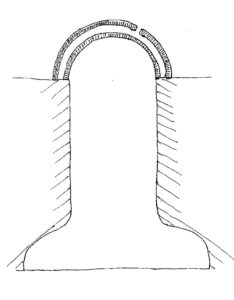
Doppelte Grabschalen auf dem Grab einer Hexe
(fn M52a): Wenn der Wahrsager kurz nach dem Tod feststellt, dass die Tote eine Hexe war, werden ihr kurz vor der Grablegung Beine und Arme in den Gelenken gebrochen. Wer von den Totengräbern es tut, muss geheim bleiben und die nahen Angehörigen (Frauen, Kinder) erfahren es auch nicht. Die Grabschale erhält kein Loch, wie es sonst kurz vor dem Aufstellen eingebrochen wird. Damit die Hexen-Grabanlage des Toten geheim bleibt, wird über die lochlose Schale eine weitere mit einem Loch gesetzt (siehe Zeichnung). Man kann ein solches Grab leicht erkennen, da Erde hier nicht einfällt. Die Angehörigen erkennen die zerbrochenen Knochen daran, dass das kok der Hexe nicht kommt, und hingestelltes Essen verzehrt. Bei der Beerdigung einer Hexe wird Essen auf die Grabschale gelegt.
J. Agalic (fn 86,2b+5b): Einige sagen, dass Gespenster groß und weiß sind und dass sie sich in Wind verwandeln können (d.h. unsichtbar werden). Sie leben in den dayiisa (Zimmer neben dem dalong) ihrer Mutter, anderer Verwandten oder im hohen, dichten Gras, in Höhlen usw. Sie setzen ihren alten Beruf fort (ein weibliches Gespenst kann weiter töpfern). Gespenster können nach der letzten Totenfeier oder schon vorher sterben, indem sie zum Beispiel von Hyänen gefressen werden. Sie werden dann zu einem Stein, Baum oder einem Baumstumpf. Ein Totengräber kann sie nach der letzten Totenfeier aus der menschlichen Gemeinschaft vertreiben, indem er vayaam-Medizin in ihr Versteck versprüht.
Informtion Ghanatta Ayaric (fn 86,39a): Wenn man von einem Gespenst berührt wird, schwillt der Bauch an (foali), das Haar wird rot oder fällt aus. Wenn dieses bei kleinen Kindern erscheint, kann es auch natürliche Ursachen haben.
Information Pater Kirschner (fn 86,40b): Ein watchman des Wiaga-Tierarztes sieht nachts, dass er vom Oberwachtmann kontrolliert wird. Plötzlich verschwindet der Kontrolleur vor seinen Augen, d.h. es war ein Gespenst. Der Wachtmann geht nach Hause und tötet sich mit einem vergifteten Pfeil.
Information Yaw (fn 94,5a): Böse und gute Hexen (sakpak piela) werden Gespenster, aber nur für kurze Zeit. Ein Gespenst ist die Seele (chiik) eines Verstorbenen. Nach dem Gespenstertod wird es eine schwarze Katze im Busch. Hexen können trotzdem Ahnen werden.
(fn 94,43b): Gespenster sind im dayiik. Sie sind nicht gefährlich für Fremde.
Information Anamogsi (fn 02.4b): Frage: Wer wird kok? Jeder kann kok werden. Man kann kokta nicht identifizieren. Auf meine Nachfrage, ob Hexen kokta werden, antwortet er “ja”.
Anamogsi: Wai nina la nya li baga chim kok. Fin nina dan kaa nya, fi kan chim koga, ni buuni po ba dan tugli ni, ale ni nina a nya, fi jam kpi fi baga nyin kok kama. Fi nina kaa nya fi kan nyini koga. Fi bi n baga a yen fi nina la nya oon fi n baga seba.
(Übersetzung) “Whose eyes see [other souls], can become a kok. If your eyes do not see, you do not become a kok. If they tugli (handfeed) you in your family, and your eyes can see, when you die, you become a kok. If your eyes do not see, you do not become a kok. You cannot say your eyes see, no! You cannot know witchcraft”.
[F.K. Erklärung: Manche glauben, dass Hexerei in weiblicher Linie vererbt wird. Andere glauben, dass die Hexeneigenschaft durch Nahrung, die die Mutter dem Kind gibt, übertragen wird (s. Text: tugli, to handfeed; durch die Mutter).
Information Leander Amoak, 27.4.76: Ein kok kann jede Farbe annehmen.
Eigene Beobachtung und Information Ayomo Ayuali (fn 88,87b): Ich [F.K.] beobachte, dass die Wände aller Räume seines Gehöft schwarze Kreuze aus vayaam-Medizin tragen. Sie sollen Gespenster (kokta) abwehren, denn diese hassen den Geruch von vayaam.
Ansoatengs Berufung zum Totengräber (fn 88,99ff): Eine ausführlichere Darstellung über die vayaam-Typen findet sich im Abschnitt 3.3.
Es gibt 6 Typen von vayaam-Medizin je nach den Eigenschaften und Todesarten der Verstorbenen:
Typ 3: für einen sakpak (Hexe, Hexer), Typ 6: für Tote, die als kokta noch herumwandeln wird die dundum Medizin, ein grober rot-brauner Sand, zum Schutz der Überlebenden gegessen.
Ansoateng weiß vor der Bestattung, dass ein Toter ein Hexer (eine Hexe) ist. Er kneift den Toten in den Arm. Wenn der Tote zurückkneift, ist er ganz sicher, dass der Verstorbene ein Gespenst (kok) werden wird, und er versucht die passende Medizin zu finden.
Aduedem 2018: Joseph Aduedems Examensarbeit zur Erlangung eines “Certificate in Philosophy” ist die umfangreichste Darstellung über Bulsa “ghosts”. Eine weitgreifende Übernahme seiner Daten und Intrepretationen würde den Rahmen dieser Darstellung über Tod und Totenfeiern sprengen. Im folgenden erscheinen daher nur einige wichtige Zitate aus dem Teilen 2.2. bis 2.5 (The Builsa Ghost):
p. 14: The Builsa conceive their ghost to be a living thing… as a result of the transformation of a deceased person.
p. 15: …it (the ghost) is not the body of the deceased person
p. 16: …It is neither the soul nor the spirit.. This will lead one to conclude that becoming a ghost may be another manifestation of the spirit of witchcraft…
p. 16: After death those with witchcraft first open their eyes and then transform (not bodily) immediately into living beings again in the form of ghosts.
p. 16f: Where there are people around… the person first turns into a smaller creature such as a wall-gecko, lizard, house-fly etc. and after escaping the crowd he/she then changes into the ghost (information: through Aduedem Alanjo). On the other hand, if it is after burial, the person becomes the ghost inside the grave and then opens the pot and comes out (kok nyinika) or he/she perforates [digs?] a small tunnel from the grave through a different part and comes out.
p. 17: The dead person (who is believed to be the wizard/witch) himself or herself after opening her eyes and probably without sufficient reasons to come out as a ghost (nyini kok) can decide to sleep in the silence of death again. This he/she does by just eating/swallowing soil in the grave and closing the eyes again, and forever he/she will not get up as a ghost.
p. 18: The Builsa ghost therefore has both material and immaterial features… Though it is not the mortal remains of the person that is the ghost, the ghost is ‘bodily’ in most aspects. It eats, plucks groundnuts, steals things… The ghost is considered immaterial in the following sense. First of all, no non-witch (in Buli piela) can see the ghost clearly and describe it substantially… Another thing is that though it walks and moves, this is almost at a greater speed and it is said that it moves with the wind because it (the ghost) is ‘air’ or ‘spirit’.
p. 20: One important thing is that the ghost can only touch one person at a time. Thus, when two or more people are moving they are holding each other… and [if they] are even touched by the ghost, none of them will die. So in instances like these, the ghost frightens them until they separate and it will then touch them as many as it can or desires.
p. 20: The limits and death of the ghost: …The first is the magical potent called vayiam [vayaam] taken by gravediggers for fortification…
p. 21: …It is said that after touching somebody, the ghost itself will also die (not immediately). Or better still the ghost dies after a particular time but one cannot tell exactly how long.
p. 22: The fate of a victim: After one has been slapped/touched by a ghost, it is an “irreversible” death sentence… He/she [the victim] will gradually begin to look pale, the beginning [and his body begins] to get swollen, the stomach bloated and the hair looks curry [curly?]. This condition in Buli is known as fualika [Endnote 113].
p. 24: It is believed that once a ghost touched/slapped somebody, when something cuts the person and blood comes out, he/she will die… Mysteriously too, when a ghost’s victim drinks an egg (not boiled) he/she will die.
3. Inkarnation in Tieren
Information Bawa Leander (fn 88,150b): Nach dem Tode nehmen Tote bestimmte Gestalten an: 1. choruk, ein raubtierartiges Wesen (Bawa: kanangchoruk): Leute aus Chana (außer Chana-Basungsa) und Navrongo, 2. jiruk (diurnal bird of prey): Chana-Basungsa, Nakong; 3. kok: die meisten Bulsa, Kadema, Sandema, Wiaga, 4. ngaukta (Krokodile): Yiwaasa. Wenn in Yiwaasa ein Kind stirbt, kann man am 3. Tag am Damm das Kind als Krokodil sehen. 5. piuk (Hyäne): Gbedema, Kanjaga, Fumbisi, 6. gbengma (lions): Wiesi, 7. juma (Fische): Kolugu bei Navrongo
Information Margaret Arnheim (fn M2): Nach dem Tod verwandeln sich Menschen in Tiere oder bestimmte Geister. Einige behaupten, dass dieses nur bei Hexen der Fall ist. Als Tiere leben sie im Busch. Wenn eine alte Person stirbt, hört man das Geschrei der Tiere, in deren Art sie sich verwandeln wird, denn die anderen Tiere holen ihre Artgenossen ab. Als Asages Mutter in hohem Alter starb, schrie eine Hyäne (für Kanjaga?). Tiere/Geister sind für bestimmte Orte verschieden: Doninga und Bachonsa: chorta, Wiaga: waaung (Affe), Gbedema: mosuk kinkeri (schafsgroße Antilopenart mit Geweih, lebt an Wasserstellen, ist nach Bawa ein Fabeltier), Uwasa und Wiesi-Kunkwak: Python; Kanjaga: piuk (Hyäne), Kadema: yueng peng (Igel), Siniensi: bush cat; Fumbisi: goai naab, (Buschkuh, Büffel). In Fumbisi singt man beim Tod eines alten Mannes folgendes Lied:
Goai naamu a nyin ngmang ngmang (The buffalo left in a cool way)
A jaa zaan pungku teng (It stood near a rock)
Goai naamu a nyin ngmang ngmang
Bu loansi moai ale pieli (It has got red and white patches).
4. Totenreiche
Information Margaret (fn M50a+44a): Das Totenreich Gbinaansas (ganz Gbedemas?) liegt bei einem Damm von Siniensi. Margaret wollte die genaue Lage wissen, damit sie nicht aus Versehen einmal dorthin kommt. Man sagte es ihr nicht. Ihr Schutzgeist werde sie davon abhalten.
Information Godfrey Achaw (fn 73,50): Jede Sektion hat einen Ort, zu dem die Toten nach dem Tode ziehen. Die Seelen aus Sandema, Siniensi, Wiaga und Kadema gehen zum gleichen Ort (Ajiroa), der nördlich von Navrongo in Burkina Faso liegt. Auch in der Nähe von Kalijiisa (meistens im Busch) gibt es Totenreiche, nämlich von Bilinsa, Kori, oder Teilen von Wiaga. Wenn jemand zum Totenreich seiner Sektion geht und einen verstorbenen Bekannten dort sieht, wird er sterben. Man nimmt an, dass er diesen Platz so liebt, dass er ihn besucht. Je näher man mit Toten verwandt ist, desto größer ist die Gefahr. Der Besucher wird von dem Toten getötet, den er gesehen hat. Wenn Bilinsa-Leute im Busch Feuerholz holen, nähern sie sich ihrem Totenreich nur auf etwa 500 Meter. Die Toten wollen nicht, dass Lebende zu ihnen kommen und sind daher sehr aggressiv. Für Fremde besteht hier keinerlei Gefahr, denn er kann diese Toten nicht sehen.
Im Totenreich gibt es einen Platz für Gute und für Schlechte. Wahrscheinlich gibt es keinen Lohn oder Strafe, aber Godfrey ist sich nicht sicher.
Der Tote kommt nicht zurück zu den Hinterbliebenen, nur die Seelen von Hexen können Leute heimsuchen [F.K.: als kok?], die ihnen im Leben etwas Böses getan haben. Bei Berührung stirbt die Person. Godfrey glaubt, dass die Hexenseele nach dem Tod des Körpers noch eine Zeitlang im Dorf bleibt und dann in das Totenreich einzieht.
(fn 73,178a): Es gibt Widersprüche: Manche sagen, die Seele geht nach dem Tod zu Gott. Andere sagen, dass sie zum Totenreich Ajiroa geht. Wenn ich sterbe, werde ich in Ajiroa mit meinem Körper neu geboren, aber Fremde können mich nicht sehen. Man erwartet aber gleichzeitig noch Körperreste im Grab. Die Speisen in dem Raum, in dem sich die Matte befindet, sind für das chiik des Toten. Jeder kann die Speisen später essen, nur nicht der Gatte oder die Gattin der Verstorbenen.
Information Leander Amoak (fn 73,129a): Alle Nachkommen Atugas (Wiaga, Sandema, aber nicht alle Sektionen dieser Orte) haben ihr Totenreich in einem geheimen Teich Agira (Ajiroa) bei Chana (zwischen Kayare und Burkina). Der Fluss trocknet nie aus. Die Seelen dort (chiisa) sterben nie wieder.
(fn 81,19a): In Badomsa liegt das Totenreich Akpeem Bulik einer Sektion aus Doninga (nahe Akasilik yeri, bei einem Brunnen [bulik] oder Tümpel).
Information Thomas Achaab aus Sandema Choabisa (fn 73,151b): Ihr Totenreich liegt bei Chana, das der Atugabisa bei Chuchuliga [sic].
Information James Agalic (fn 86,2), Magisterarbeit: Auch nach einem kum-biok (z.B. Selbstmord), nach Hexerei oder kambong (Ehebruch) wird man Ahne.
Azognab 2020: 54 [Leben im Totenreich]: I was told that work is no more seen as a difficult task but happy exercise as part of life. Livestock such as animals and birds are still reared there and farming still goes on. That is why during the funeral, animals and birds are used [killed] so the deceased can go and start rearing there. The family still know their members and hence, welcome new members from this world into their midst. There is also day and night in kpilung in the minds of these respondents.
p. 56: The third question was: What happens if one’s death and funeral rites are not performed. All the fifteen (15) respondents said that the deceased person may not be able to enter Kpilung (the land of the living dead) if the necessary death and funeral rites are not properly done.
They further said that the deceased would in that situation remain on the way to Kpilung. For Akanwarilami Ataasapo, this could bring about devastating effect on the relatives of the deceased [Endnote 114]. It is believed that a deceased person has the power to cause Kpaata (something bad that happens to a person who has a spiritual source).
p. 69: All the killing of animals for the nang foba, kpalungta and cheri deka rituals emanate from theological reasons, that the deceased goes home with nitalim (property) to start life.
5. Ahnenstatus
Vgl hierzu Kröger: 1982 (Ancestor Worship) und 2003: 243-262
Beobachtung F.K. (fn 88,140a): Ayomo Ayuali setzt beim Bau eines Speichers einen runden Stein in die Mitte des frisch verputzten Bodens. Dieser Stein wird später sein Ahnenstein vor dem Gehöft (ausführlich bei Kröger 2001: 39-40).
Information Danlardy (fn 01,7b): Eine tote Person heißt kpiu(k). Etwa 5-6 Jahre nach dem Tod, d.h. wenn man ihren Tod vergessen hat, wird das wen des Verstorbenen im wen-teng-nyinika Ritual vor das Gehöft gebracht (Kröger 1978: 161). Danach folgt das tu-poak laka-Ritual (Errichtung eines Ahnenschreins.
(fn 01,63b*): Der Name kpilima wird auch für Tote gebraucht, deren Totenfeier noch nicht stattgefunden hat.
Information James Agalic, Magisterarbeit, S. 128 (fn 86,5a): Durch das Hinausführen des wen erhält der Verstorbene Ahnenstatus. Ein neuer Schrein wird hinter [F.K. vor oder neben] dem kusung–dok errichtet. Verwandte kommen mit einem Huhn oder Perlhuhn. Es wird Hirsebier ausgeschenkt. Wenn der Ahne seinen Schrein am guuk des Gehöfts haben will, wird dort eine kleine Hütte (kpilima dok) errichtet mit einem Topf Wasser, Kalebassen etc. Der Ahne benötigt diese Dinge.
Information Godfrey Achaw (fn 73,51b): Das wen des Toten kann erst nach den Totenfeiern vor das Gehöft gebracht werden. Der Wahrsager ordnet es so an, nachdem man ihn zum Beispiel wegen einer Krankheit im Haus befragt hat. Bei der Ausführung werden viele Opfer (Hühner, Perlhühner und Ziegen) den wichtigsten Schreine des Gehöfts geopfert. Eine Musikkapelle mit Trommlern spielt, es wird getanzt und viel Pito getrunken. Alle Töchter des Hauses sollen an diesem Ritual teilnehmen.
Kröger 1982: 18 [Besuch in Zamsa]: … On the surface, next to Atengdaara’s bogluk, we found a few beer bottles of a Ghanaian brewery. The three ancestors had asked for such modern vessels in order to be able to fetch water from a pond not far from the guuk (siehe auch Plate 18).
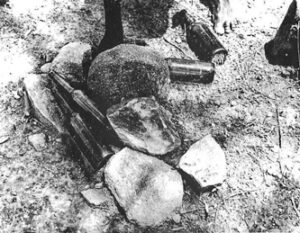
Beer bottles on an ancestral shrine in Zamsa
- Titel, Vorwort, Inhalt, Einleitung
- Schwangerschaft und Geburt
- Namensgebung und Namen
- Skarifizierungen
- Wen-Riten
- Beschneidungen
- Brautwerbung und Ehe
- Tod, Trauer und Bestattung (1. Teil)
- Tod und Bestattung (2.Teil)
- Die Kumsa Totenfeier
- Die Juka Totenfeier
- Schluss
- Anhang
- Literaturverzeichnis
- Gesamtedition der Übergangsriten